Explainer
What a shop's collections and menus tell you about its customers
How a shop groups its products is a decision about who it is selling to. Reading those groups takes ten minutes and tells you more than most competitor data.
Published 7 min read
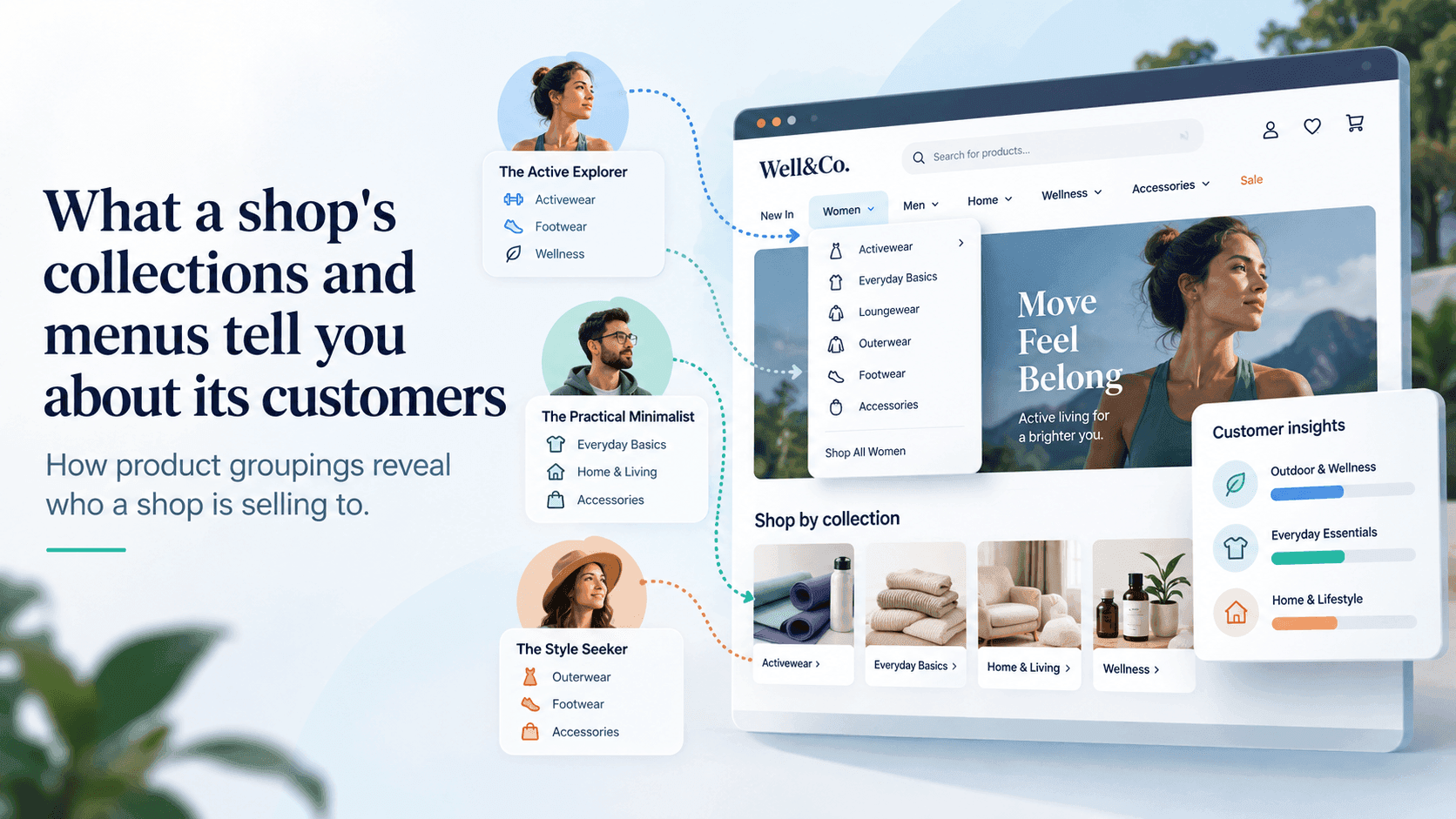
A shop's menu is a decision about who it is talking to. Grouping products by occasion rather than by type, putting "gifts" first, having a "starter kit" at all — each of these is somebody choosing how a customer should be led through the range. It costs nothing to read, needs no tool, and it tells you more about a competitor's intended customer than their prices do.
Where to find the groupsLink to this section
The menu is the edited version: the groups a shop thinks matter most. Look at the order, and at what is missing.
The full list of groups is usually longer than the menu. Every Shopify store publishes a sitemap automatically, and it points at a separate file listing the shop's collections — so you can see groups that exist but are not in the menu, which is often where the interesting ones are.
The footer carries the groups a shop wants for search rather than for shoppers.
Ten minutes across all three.
What the grouping style tells youLink to this section
Grouped by product type ("mugs", "plates", "bowls") is the default. A shop doing only this is organised around its stock rather than its customer. Common in shops that grew by adding products.
Grouped by occasion or need ("for a new home", "weekend coffee", "gifts under £30") is a shop that has thought about why someone is buying. It usually means they know their customer well and often that they sell more per order, because those groups do the suggesting.
Grouped by customer type ("for beginners", "for professionals") means a shop that has decided it serves more than one kind of person and is willing to sort them at the door.
Grouped by collection or season ("autumn 26") means a business with a calendar — fashion, homeware, anything that turns over seasonally. Expect predictable markdown cycles.
Grouped by brand means a retailer rather than a maker. Different economics entirely: their margins are thinner and their competitive position rests on range and service rather than on product.
The specific things worth notingLink to this section
What comes first in the menu. Not an accident. The first item is what the shop most wants a new visitor to see.
Whether "sale" or "outlet" is in the menu. A permanent sale group is a pricing strategy, and it means a proportion of their customers never pay full price. Worth knowing before you match a headline discount.
Whether "new in" exists. A shop with a prominent new-arrivals group is telling you it launches often enough for that to be worth a menu slot — and that returning customers are expected to check.
Whether there is a gift section, and when it appears. A gift group that appears in October and vanishes in January tells you how much of their year is Christmas.
Whether there is a bundle, kit or starter group. A shop trying to raise order value, and usually one that knows what a new customer should buy first.
A group with very few products in it. Either something being built up, or something being wound down. Check it again next month and you will know which.
Groups that exist but are not in the menu. Frequently the most revealing thing on this list. These are often built for search, for a campaign, or for a partner — a group aimed at a market the shop is testing quietly.
Reading the shapeLink to this section
Two counts, both quick:
- How many groups, against how many products. A shop with forty products and thirty groups is over-organised:
most groups will hold two or three items, which usually means they were made for search rather than for shoppers. A shop with eight hundred products and six groups is under-organised and probably hard to shop.
- How deep the menu goes. Groups inside groups suggest a large, considered range. A flat menu suggests a shop
that expects you to browse everything.
Neither is good or bad on its own. Both tell you how much thought — and how much staff time — the shop puts into merchandising.
Watching it changeLink to this section
The groups a shop adds are one of the clearest statements of intent it makes publicly, and they change rarely enough that any change is meaningful.
- A new group is a new bet: a category, an occasion, a customer type.
- A group disappearing is a retreat, or a tidy-up.
- The menu reordering is a shop deciding something else matters more now.
Save a dated copy of the menu once a month. It takes a minute, and unlike most competitor data it stays readable forever — a year of monthly menus is a legible history of a shop's strategy.
The menu as a record of what they triedLink to this section
Groups are cheap to make and awkward to delete, so a shop's full list of collections tends to accumulate its history: the Christmas group from two years ago, the collaboration that ended, the category they tested and dropped.
That accumulation is useful. The groups in the menu tell you what a shop is doing now; the groups that exist but are not in the menu tell you what it has tried. A shop with an abandoned group for a category you are considering has already run the experiment you are about to run — and the state of that group, whether it still has products and whether they are discounted, hints at how it went.
How this reads against the price bandsLink to this section
Grouping and pricing answer the same question from two directions, and they are most useful read together.
A shop whose groups are organised by occasion and whose prices sit in a narrow band is confident about who it serves and what they pay. A shop with occasion-based groups and an extremely wide price range is trying to serve several customers at once, which is harder and usually less profitable than it looks.
And a shop whose menu leads with "sale" while its price bands show a permanently discounted quarter of the range is telling you plainly that discounting is the proposition rather than an event. Reading price bands is the natural next ten minutes after this.
What this cannot tell youLink to this section
Whether any of it works. A beautifully organised shop can convert badly. This shows intention, not results.
What their customers actually do. A shop can lead with gifts while most of its sales come from elsewhere. Only the shop sees that.
How current it is. Menus are edited rarely. A group may reflect a decision made two years ago by someone who has left.
How many products are really in each group. The published information about collections does not include a count per group, so you have to look, or infer it from the products themselves.
Where it fitsLink to this section
This is the cheapest signal in competitor research and the one most often skipped, because it feels too simple to be worth writing down. It belongs in the first ten minutes of any competitor review, next to the catalogue and the prices — and unlike most of the rest of it, it needs no tool, no spreadsheet and no account.
Related readingLink to this section
- How to see a Shopify store's whole product catalogue
- A competitor research checklist you can run in 30 minutes
- Shopify competitor analysis: a practical guide
SourcesLink to this section
- Shopify Help Center, Finding and submitting your sitemap (every store generates one automatically, with separate files for products, collections, pages and blogs) — https://help.shopify.com/en/manual/promoting-marketing/seo/find-site-map — read 2026-09-22
- Our own check of a public store's sitemap on 2026-09-22, which listed a separate collections file
Written by Pinto Arkad
I love shopify