Explainer
What you can and cannot learn about a store from outside
A straight list of what a Shopify store publishes about itself, what is guesswork, and what nobody outside the business can see at any price.
Published 5 min read
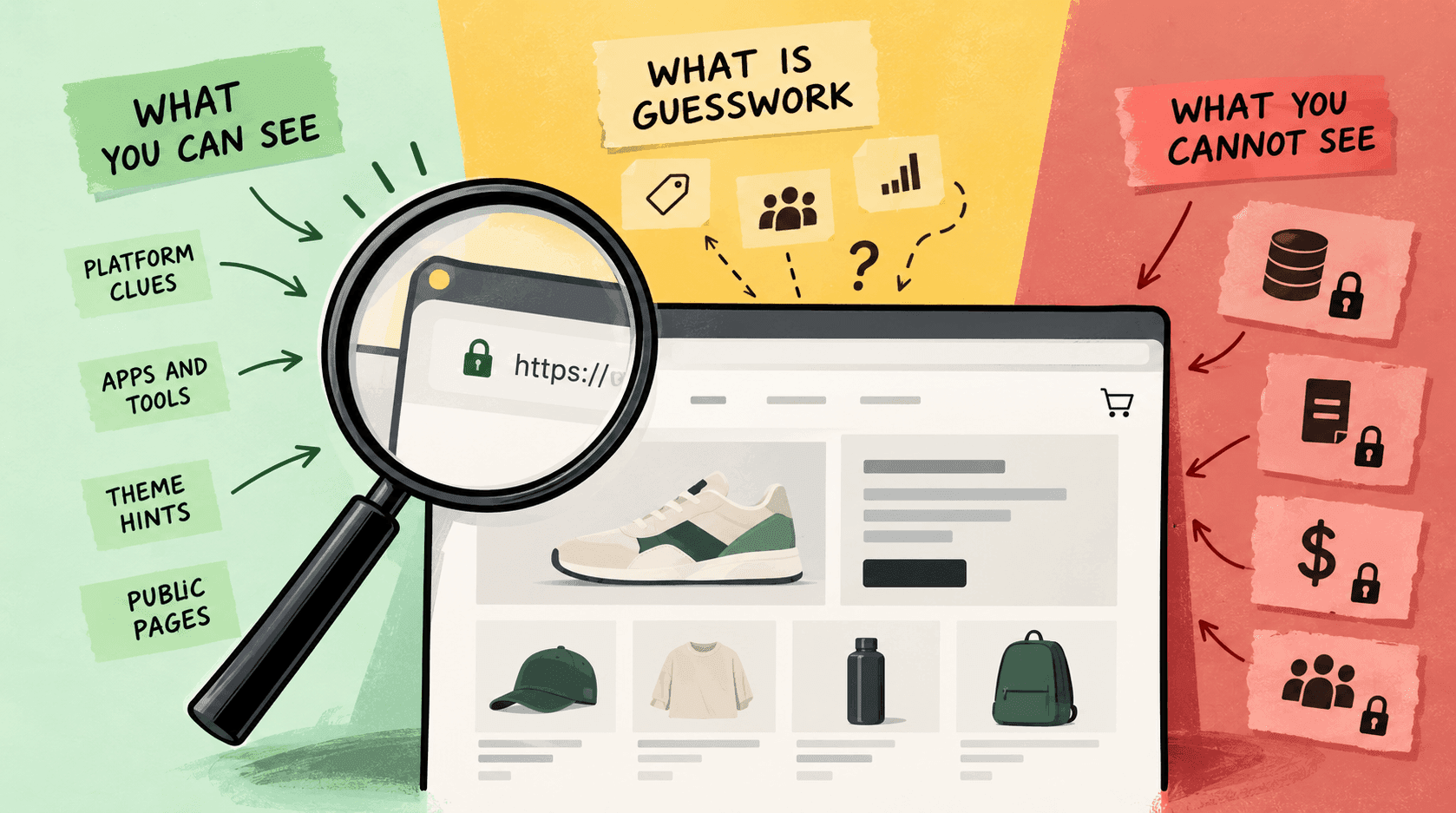
A shop is a shop window. You can see everything it puts out front — its products, its prices, what is marked down, what it has just launched, what software it visibly runs — and none of what is in the stockroom or the accounts. Here is the full list, sorted into three honest groups: what a shop publishes as fact, what is a modelled guess, and what nobody outside the business can see at all.
Group one: published factsLink to this section
These are things the shop itself puts out in public. You are not inferring anything; you are reading.
| What | Where it comes from | How reliable |
|---|---|---|
| Every product on sale, with its name and description | The shop's own product list | Exact |
| Every listed price, and the original price when something is discounted | The same list; Shopify shows both when a shop sets a compare-at price | Exact for listed prices |
| Whether each variant is currently available to buy | The same list | Exact |
| When each product was created and published | The same list | Exact dates, but see the warning below |
| How many products and collections the shop has | The shop's own counts | Exact |
| How the shop organises its range | Its collections | Exact |
| The shop's name, description, location, currency and contact details | Its own pages | Exact |
| Its blog and content pages | Its sitemap, which every Shopify store publishes automatically | Addresses and dates, not always titles |
| Features a shopper can see: reviews, subscriptions, bundles, loyalty, pop-ups | Browsing it | Exact, as far as a shopper sees |
| Which platform it runs on | Standard public addresses | Usually certain |
The warning on dates: a shop's own dates are exact, but they answer a slightly different question than you might think. "Created" is when someone typed the product in; "published" is when shoppers could buy it; "updated" moves when anything at all changes, including a photograph. They are facts about the shop's records, not about the shopper's experience.
Group two: modelled guessesLink to this section
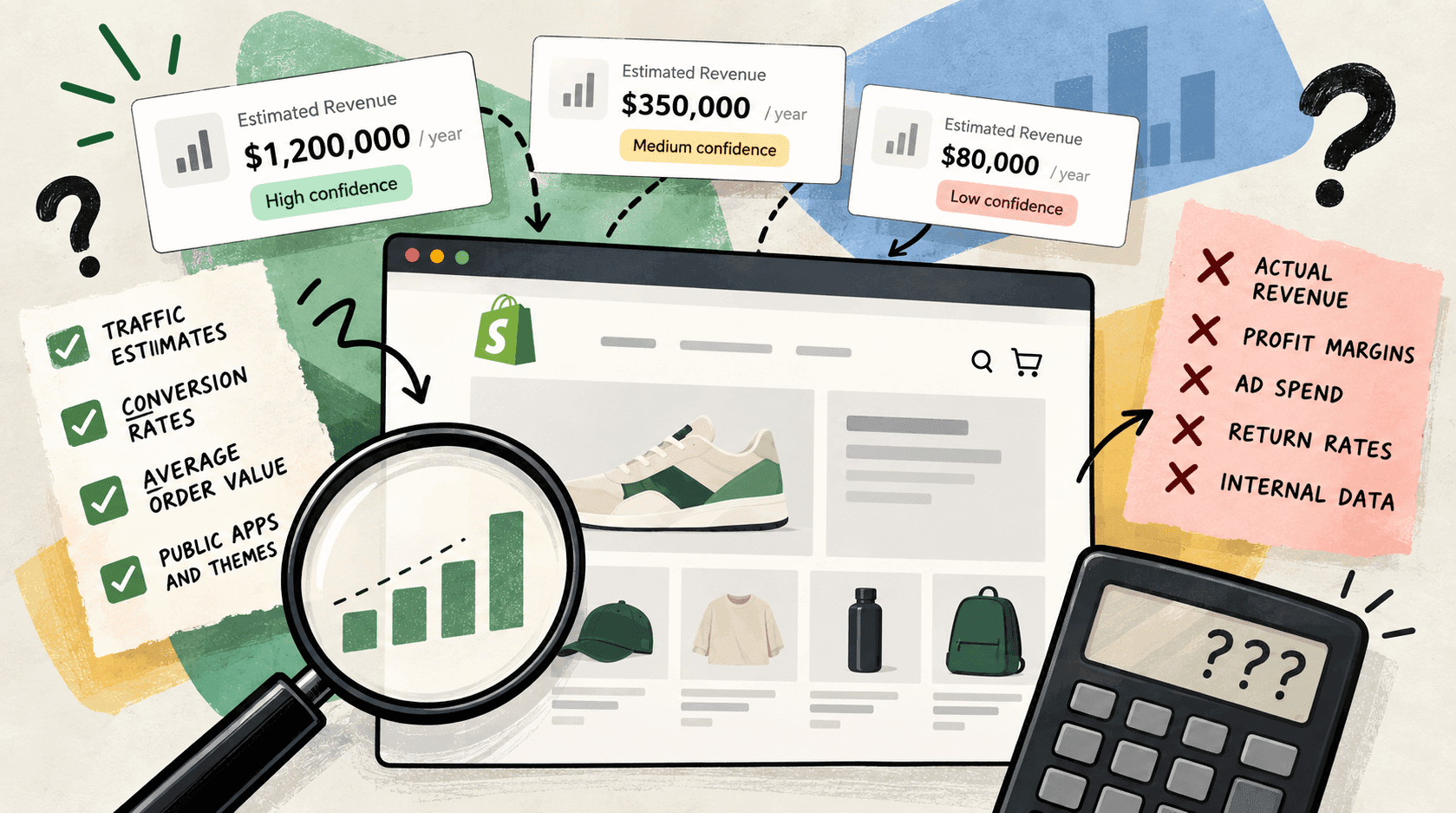
These are the numbers people most want and the ones most often presented as facts. They are not facts. They are the output of a model built on public signals, and they carry real error bars.
| What | Why it is a guess | How to treat it |
|---|---|---|
| Monthly visitors | Estimated from sampled browsing data, extrapolated | Order of magnitude only |
| Revenue | Visitors × an assumed conversion rate × an assumed order value — three uncertain numbers multiplied together | A range with a confidence label, or nothing |
| Which country a shop's visitors come from | Same source as the visitor estimate, same limits | Broad shape only |
| How much of the catalogue is discounted | Countable from listed prices, but silent discounts are invisible | Reliable as a floor, not a total |
| Which apps a shop runs | Only apps that leave a mark on the public pages | Always a partial list |
| Which theme a shop uses | Readable, but often renamed by the shop | The family, rarely the exact answer |
| How big the shop is relative to a competitor | Comparing two estimates built the same way | The most defensible use of any estimate |
That last row is worth dwelling on. Estimates are far more trustworthy relatively than absolutely. "This shop looks roughly three times the size of that one" survives a lot of model error, because the same assumptions apply to both. "This shop makes £40,000 a month" does not. There is a fuller explanation in how store revenue estimates are built and how wrong they can be.
Group three: invisible, at any priceLink to this section
No tool can show you these, and any that claims to is either guessing or getting it from somewhere it should not.
- Costs and margins. A competitor undercutting you may be making more per order than you, or losing money on every sale. Nothing outside distinguishes those.
- Marketing spend. You may be able to see that a shop advertises. What it spends, and what it gets back, is private.
- Stock counts. You can see that something is available or sold out. Never how many.
- Customer numbers, repeat purchase rate, lifetime value, email list size. All private, and all more important than anything in group one.
- Discounts that are not on the product page. Codes, basket-level offers, email-only deals, prices set for one country. The listed price never moves for any of these.
- Wholesale and other channels. A brand that looks small online can be substantial in shops.
- Returns. A category with heavy returns loses a large slice of its apparent revenue after the sale.
- Anything about the people. Who works there, who is leaving, what they are planning.
- Anything behind the checkout. Shopify's own documentation notes that app blocks cannot be rendered on checkout pages, so software a shop uses only at checkout leaves no public trace.
Why the invisible list matters more than it looksLink to this section
The temptation in competitor research is to work with what you can see and quietly assume the rest follows. It does not. The invisible column contains most of what actually determines whether a business is healthy — margin, repeat purchases, cost of acquiring a customer. A shop can look impressive in every visible respect and be in trouble.
So the useful discipline is: treat group one as evidence, group two as a hint, and group three as a reason to stay humble. A competitor analysis that reaches a confident verdict about a rival's health has overreached, no matter how much data went into it.
What good research looks like, given all thatLink to this section
- Lead with counted facts. Product count, price range, what is discounted, what is new. These are true and checkable, and they answer more strategic questions than a revenue guess does.
- Use estimates comparatively and label them. Range, date, confidence. Never a single figure.
- Write the unknowns down explicitly. In a client document, a short "what we could not determine" section is the thing that makes the rest credible. It also protects you when someone later discovers the shop had a wholesale business nobody could see.
- Watch changes, not snapshots. What a shop does over time is visible and meaningful: launches, withdrawals, price moves, apps appearing. Change is the most honest signal available from outside, because you are comparing the shop to itself rather than to an assumption.
That last point is the whole argument for tracking rather than looking. A snapshot needs interpretation. A change is a fact.
Where StoreLenz sits in thisLink to this section
We are building the group-one and change-over-time parts: you name the shops, we read what they publish on a schedule, and tell you what moved. Group two we show as ranges with a confidence label, and when there is not enough signal to model a shop we say so instead of inventing a number. Group three we do not claim at all. What the product does today is written out plainly, including the parts still being built.
Related readingLink to this section
- Shopify competitor analysis: a practical guide
- How to estimate a Shopify store's revenue — and how wrong it can be
- How to find out which apps a Shopify store is using
SourcesLink to this section
- Shopify Help Center, Finding and submitting your sitemap — https://help.shopify.com/en/manual/promoting-marketing/seo/find-site-map — read 2026-09-22
- Shopify Help Center, Setting sale prices for products — https://help.shopify.com/en/manual/products/details/product-pricing/sale-pricing — read 2026-09-22
- Shopify.dev, Configure theme app extensions (app blocks cannot be rendered on checkout pages; app embed blocks are deactivated by default after install) — https://shopify.dev/docs/apps/build/online-store/theme-app-extensions/configuration — read 2026-09-22
- Our own checks against public stores, 2026-09-22, and our testing of store lookups and estimates across a set of real public shops, September 2026
Written by Soneth Martins
shopify store manager