Explainer
Is it legal to monitor competitor Shopify stores? Public data explained
Reading a shop's public pages is ordinary business research. Here is where that stops being true, and the five rules worth holding yourself to.
Published 6 min read
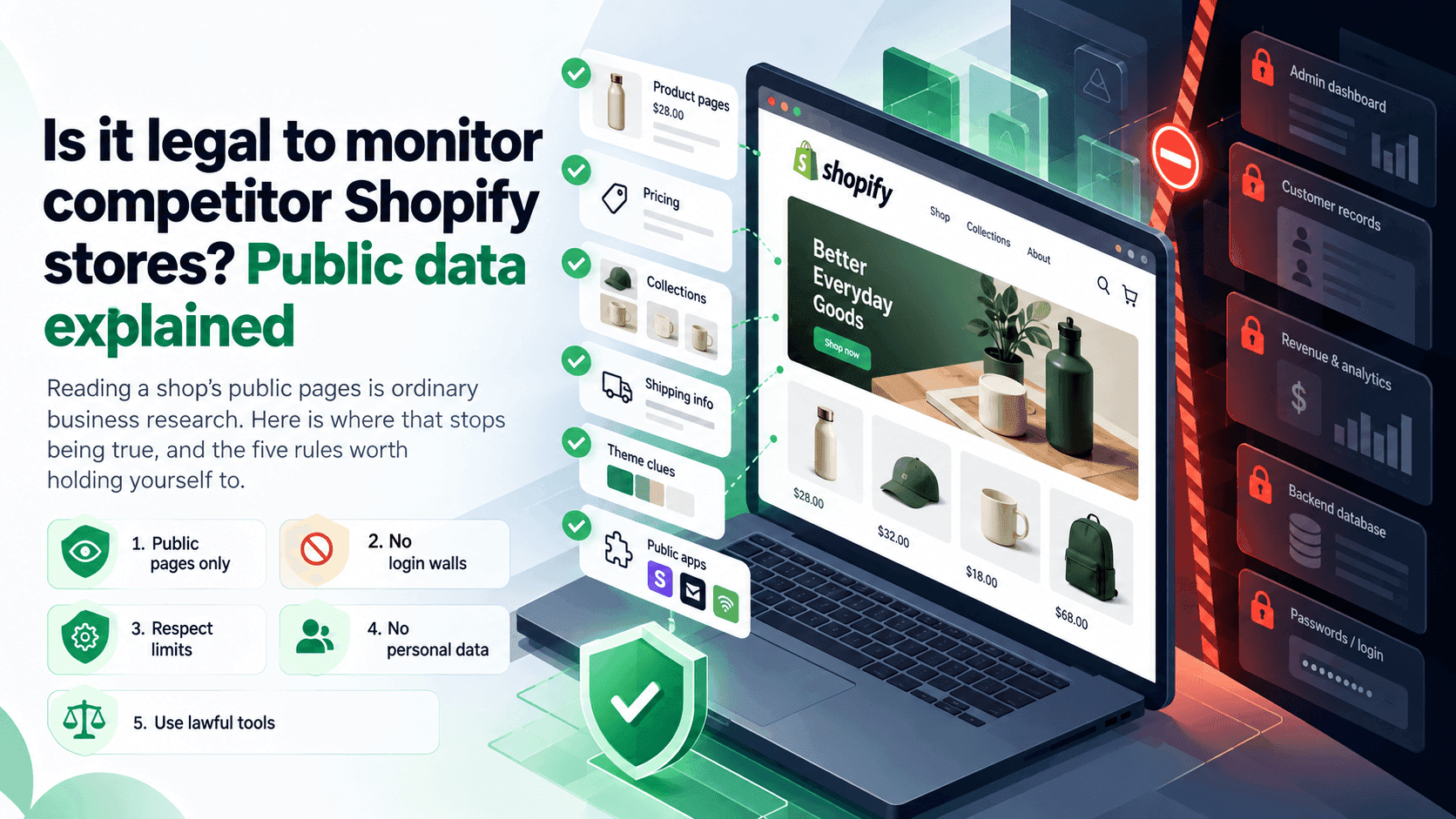
Looking at a competitor's shop is what shopkeepers have always done. Reading their published prices, counting what they sell, noticing a new line and seeing what they put in the window is ordinary business research, and putting it in a spreadsheet does not change that. Where it stops being ordinary is fairly clear, and worth stating plainly rather than tiptoeing around.
This is not legal advice. Rules differ by country, by contract and by circumstance, and a blog cannot tell you what applies to your situation. What follows is the standard we hold ourselves to.
The principleLink to this section
A shop's public pages are a shop window. They exist to be looked at, by customers, by search engines and by anyone else. A shop chooses what to put there.
Everything else belongs to the shop. Their admin, their orders, their customer list, their costs, their supplier terms, their accounts. Not yours, whatever you could learn from them.
Almost every question about fairness in this area resolves by asking which side of that line something sits on.
Five rules worth holding yourself toLink to this section
1. Read what is published, never what is protectedLink to this section
Product pages, prices, the shop's own product list, its sitemap, its collections, its blog — all published, all intended to be read. A password-protected area, a staff account, an unpublished page found by guessing an address: not yours, regardless of how easy it is to reach.
If you need a login you were not given, stop.
2. Do not take more than a customer wouldLink to this section
A shop's website is run at their expense. Reading a few pages is browsing. Hammering a small business's site with thousands of rapid automated requests costs them money and may knock their shop over, which is a real harm to a real person regardless of whether the pages are public.
Pace it. Space requests out. Take what you need and stop. The catalogue method is deliberately written to be a handful of pages a few seconds apart, and that is the right shape.
3. Leave people out of itLink to this section
This is the rule that matters most and the one most often broken by accident.
Competitor research is about a business: its products, its prices, its range. It is not about individuals. That means no collecting customer names from reviews, no gathering staff details, no building lists of people, and no screenshots showing a reviewer's name or face.
Business information and personal information are different things with different rules, and the moment your research contains people you have changed what you are doing.
4. Check the terms you agreed toLink to this section
If you have an account with a service, you agreed to something. Terms of service can restrict automated access regardless of whether information is public, and terms vary — this is a genuine "read your own agreements" point, not a formality. If a project depends on it, that is a question for a lawyer, not for a blog.
5. Be able to say what you did out loudLink to this section
The most useful test there is. If you would be uncomfortable explaining your method to the shop you researched, or seeing it described in public, that discomfort is information.
Everything on this blog passes that test: it is reading pages a shop publishes, at a human pace, about a business rather than about people.
Things that are fine, and often assumed not to beLink to this section
- Buying from a competitor. You are a customer. This is the oldest research method there is and it tells you about their packaging, their delivery and their follow-up email.
- Joining their mailing list. A public list, joined the normal way. It is also the only reliable way to see discount codes, which never appear on product pages.
- Reading their published product list. It is published by the shop, for anyone.
- Recording their prices over time. They are on public pages. Writing them down does not change that.
- Noting which features their shop visibly has. You are describing their shop window.
- Telling a client what you found, provided you say how you found it and what you could not determine.
Things that are notLink to this section
- Signing up under a false identity to get at something restricted.
- Asking their staff for information by pretending to be someone else.
- Trying addresses or accounts you were not given.
- Taking enough traffic to affect their shop.
- Collecting information about identifiable people.
- Presenting an estimate as a fact about their business.
That last one is not a legal matter but it belongs on the list. Publishing a confident revenue figure for a named shop, when the figure is modelled and could be out by a factor of two, does real damage to a real business — and it is the most common way this field behaves badly. What can and cannot honestly be known from outside is the longer version of that argument.
A note on namesLink to this section
Using another company's trademark in your own branding is a separate question from research, and a well-documented one. Shopify's own trademark terms state that third-party products must not use "Shopify" in their name and must not mislead anyone into thinking Shopify sponsors or endorses them. The same principle applies generally: describe what you do, do not borrow someone else's name to do it.
Where we standLink to this section
Everything StoreLenz is being built to do reads information shops publish about themselves, at a reasonable pace, about businesses rather than people. We do not hold customer data from the shops we look at, we show estimates as ranges rather than as facts, and where there is not enough public information to answer a question we say so instead of guessing. What the product does today is written out plainly, including the parts still being built.
If you have a specific concern about your own situation, ask a lawyer in your country. That is genuinely the right answer, and anyone telling you otherwise on the internet is overreaching.
Related readingLink to this section
- What you can and cannot learn about a store from outside
- Shopify competitor analysis: a practical guide
- How to see a Shopify store's whole product catalogue
SourcesLink to this section
- Shopify Trademarks (third-party products must not use "Shopify" in their name, and must not mislead consumers into thinking Shopify has sponsored, affiliated with or endorsed them) — https://www.shopify.com/legal/trademarks — read 2026-09-22
- No law, regulation or case is cited in this article, deliberately: it states principles and points readers to a lawyer for anything specific to their situation
Written by Cristiano Pinto
shopify store expert