Comparison
Shopify competitor price tracker: free methods vs paid tools
What a free spreadsheet method gets you, what you are actually buying when you pay for a tracker, and how to tell which one your shop needs.
Published 6 min read
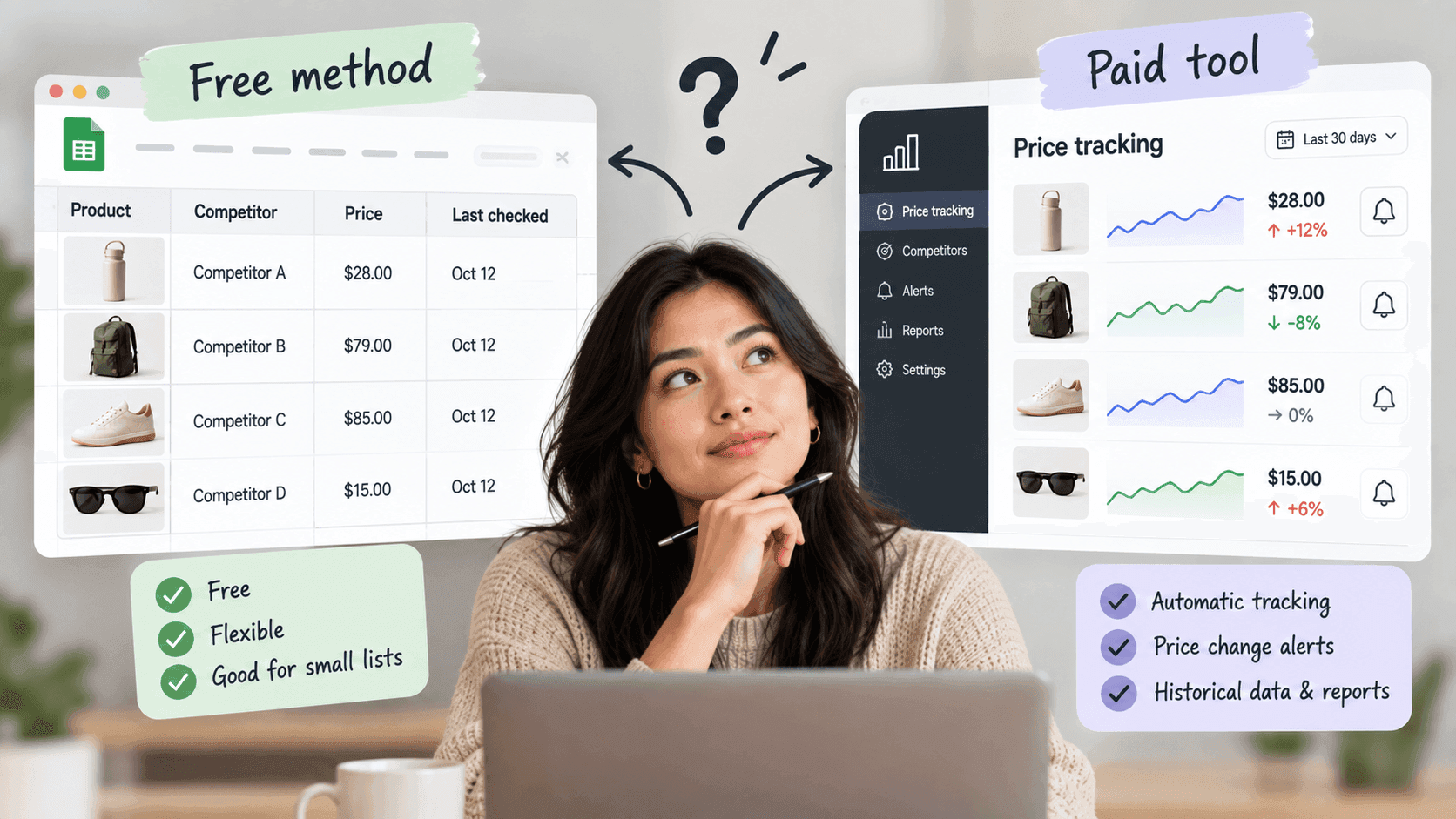
The free method is a spreadsheet and about fifteen minutes a week, and for one or two competitors it works perfectly well. What you pay for is not better data — it is the same public prices, read more often and remembered for you. That distinction is the whole decision: if your problem is getting the prices, do it free; if your problem is remembering to, that is what a tool sells.
What both approaches actually readLink to this section
Worth stating first, because it decides how much any of this can be worth to you.
Shopify stores publish their prices. When something goes on sale the shop sets a compare-at price, and Shopify's own help pages describe how the theme then shows both the new price and the original. Every tracker on the market, free or paid, is reading that same public information. Nobody has a private feed of competitor prices.
So the comparison below is not about data quality. It is about frequency, memory and attention.
The free methodLink to this section
Pull each competitor's product list into a spreadsheet, save it with the date, and compare this week's against last week's. The full method is here — it takes about fifteen minutes a week once you have done it twice.
What it genuinely gives you
- Every listed price, exactly, for as many shops as you have patience for.
- Full control of what you record and how you analyse it.
- No cost, no account, no data leaving your machine.
- A better understanding of your market, because you are looking at it yourself rather than reading a summary.
Where it breaks
- It depends on a person remembering. This is the real failure, and it is not a character flaw — it is what
happens to every weekly manual task during a busy month.
- It only sees what was true at the moment you looked. A sale that starts on Tuesday and ends on Friday is
invisible to a Monday check.
- It does not scale past about three shops. Fifteen minutes becomes an hour, and the hour does not happen.
- There is no history until you have built one. Your first check tells you nothing; the value starts in month
two.
What paying actually buysLink to this section
Strip the marketing away and a paid tracker sells four things:
- Frequency. Something looks every day, or several times a day, instead of whenever you remember.
- Memory. The history is kept from the moment you start, so you can answer "when did this change?" without
having planned to ask.
- Attention. You are told when something moves, rather than having to notice. This is the one people
underrate and the one that actually changes behaviour.
- Scale. Fifteen shops costs the same effort as one.
What it does not buy
- Better prices data. Same public information.
- The discounts nobody can see. A code sent by email, a basket-level offer, a free-delivery threshold, a price
set for another country — none of these change a listed price, so no tracker at any price can see them.
- Any idea why. You will learn that a competitor dropped prices. Whether that is clearance, a land grab or a
cash-flow problem is not in the data.
- A decision. What to do about a price cut is still judgement.
What neither approach can seeLink to this section
Worth stating on its own, because it is the ceiling on this whole category and no amount of money raises it.
Discount codes. Sent by email, posted on social media, handed to an influencer. The listed prices never move.
Basket-level offers. Three for two, free delivery over a threshold, a percentage off a first order. Applied at the basket, not on the product.
Prices set for other countries. A shop can assign a catalogue of products with its own pricing to a market, so the prices you see are one version of several.
Customer-specific prices. Trade accounts, wholesale tiers, loyalty pricing.
Why anything changed. Clearance, a land grab, a supplier increase, a test — identical from outside.
So both approaches read listed prices, which is most of the picture for most shops and is not all of it. Any tool promising complete competitor price intelligence is overselling, and the honest response to that gap is to stay on your competitors' mailing lists.
Which one your shop needsLink to this section
| If this is true of you | Do this |
|---|---|
| One or two direct competitors, stable market | Free. A tool would be solving a problem you do not have |
| You tried the spreadsheet and stopped after three weeks | Pay. You have already run the experiment |
| Five or more shops matter to you | Pay. The manual method does not survive this |
| You need to know the day a sale starts | Pay. Weekly checking cannot catch a weekend promotion |
| You need history you did not think to collect | Pay, and accept it starts from today either way |
| You are pricing off one head-to-head product | Free. Check that one product properly |
| You are in a slow-moving category | Free. Monthly is enough, and monthly is sustainable by hand |
The honest summary: most shops with fewer than three competitors should not pay for this. The free method is genuinely adequate, and we would rather say so than sell you something you will not use.
The question to ask before paying for anythingLink to this section
Not "is this accurate?" but: "what does it show when it does not know?"
Every tool in this space works from public information that is sometimes absent. A tool that always has an answer is filling gaps, and you cannot tell which answers were filled. Ask what it shows for a shop too small to estimate, or for a shop whose product list it cannot read. A tool that says "no data" is telling you something true; one that shows a confident number for every shop is telling you something about itself.
The same question applies to the free method, incidentally. When your spreadsheet has a gap because a shop blocked you that week, write "not checked" rather than carrying last week's figure forward.
Two things worth doing whichever you chooseLink to this section
Stay on their mailing list. Codes and basket offers are the discounts that never touch a listed price, and the only reliable way to see them is to be a customer. This is free and neither approach replaces it.
Watch the shape, not the products. A competitor's middle price drifting up over three months matters more than any single item moving, and it is far less work to track. Reading price bands covers this, and it is the one piece of analysis that is genuinely easier by hand than in most tools.
Where we sitLink to this section
StoreLenz is being built to be the paid side of this: you name the shops, it reads their public prices on a schedule, keeps the history and tells you what moved — with the alerts set narrowly enough that you do not mute them, which is its own article. Price tracking and alerts are being built rather than finished today, and what it does now says which is which. Plans and what each covers are on the pricing page.
If the free method is working for you, keep using it. It is the same data.
Related readingLink to this section
- How to track competitor prices on Shopify
- What a competitor price alert should wake you up for
- How to read a competitor's price bands
SourcesLink to this section
- Shopify Help Center, Setting sale prices for products (a shop sets a compare-at price and the theme shows both prices with a sale badge) — https://help.shopify.com/en/manual/products/details/product-pricing/sale-pricing — read 2026-09-22
- Our own check of a public store's product list on 2026-09-22, confirming
priceandcompare_at_priceon every variant - No competing product is named or described in this article, so no third-party claim is made about one
Written by Cristiano Pinto
shopify store expert