How to
What a competitor price alert should — and shouldn't — wake you up for
Most people turn price alerts off within a fortnight because everything is an alert. Here is how to set thresholds that only fire when something matters.
Published 7 min read
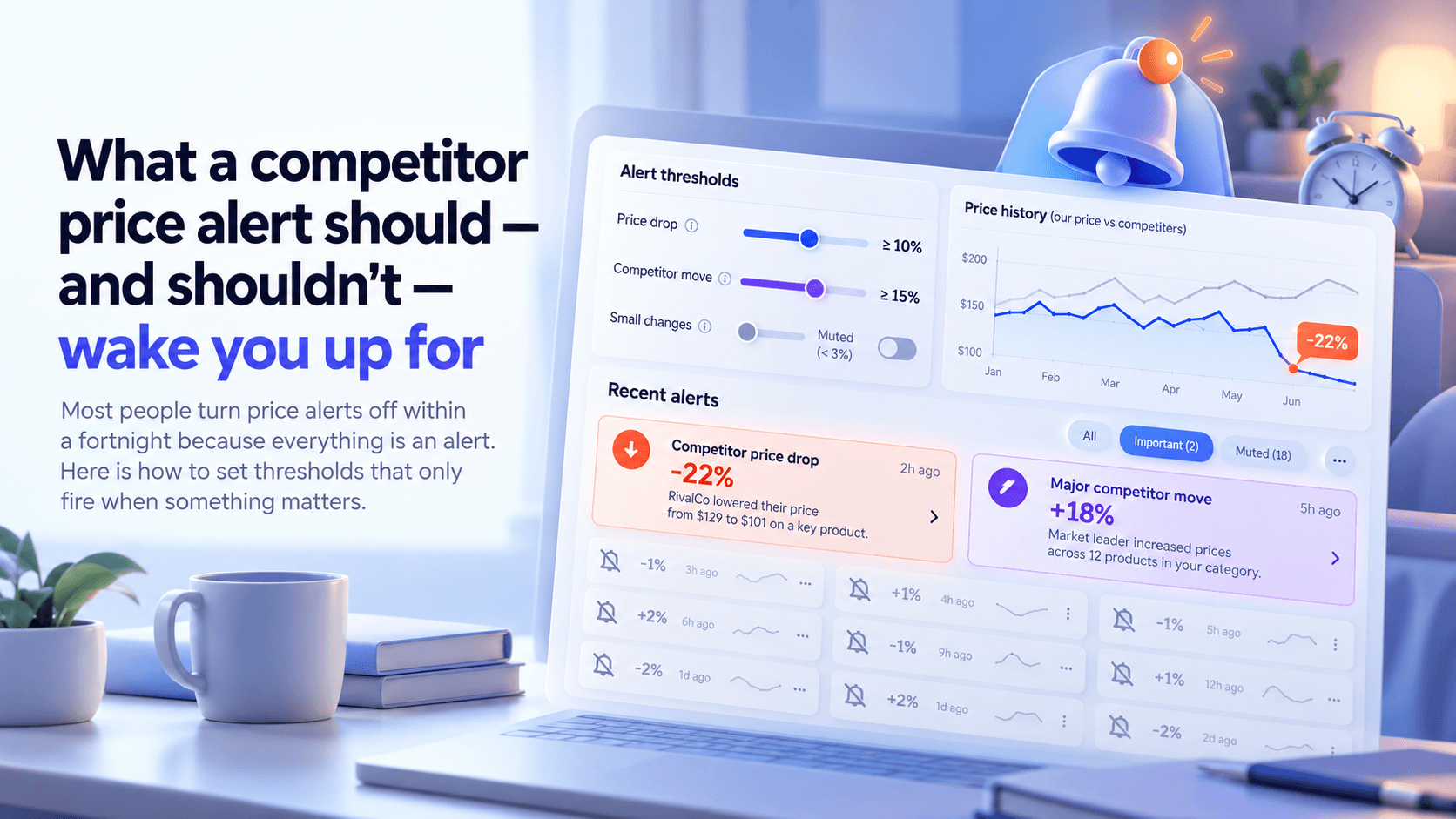
An alert is only worth having if you would do something about it. Most competitor price alerts fail because they fire on every movement — a £1 change on a product you do not sell, a shop tidying its markdowns, a seasonal line going into clearance — and after a fortnight of that, people mute the whole thing and are worse off than before they started. The fix is not a better alert tool. It is deciding, in advance, what you would actually act on.
The testLink to this section
Before switching anything on, write down the answer to one question:
If this alert arrives on a Tuesday morning, what will I do differently?
If the honest answer is "look at it and carry on", you do not want that alert. You want that information in a monthly summary instead.
Almost every alert-fatigue problem comes from skipping this question and switching everything on because it was available.
The four alerts worth havingLink to this section
1. A head-to-head product movesLink to this section
Not any product — the three to five items where a customer would genuinely put your product and theirs side by side. A price change on one of those is worth knowing the same day, because it may change what you charge.
Suggested threshold: any change at all, on that short list only.
2. A competitor starts a real saleLink to this section
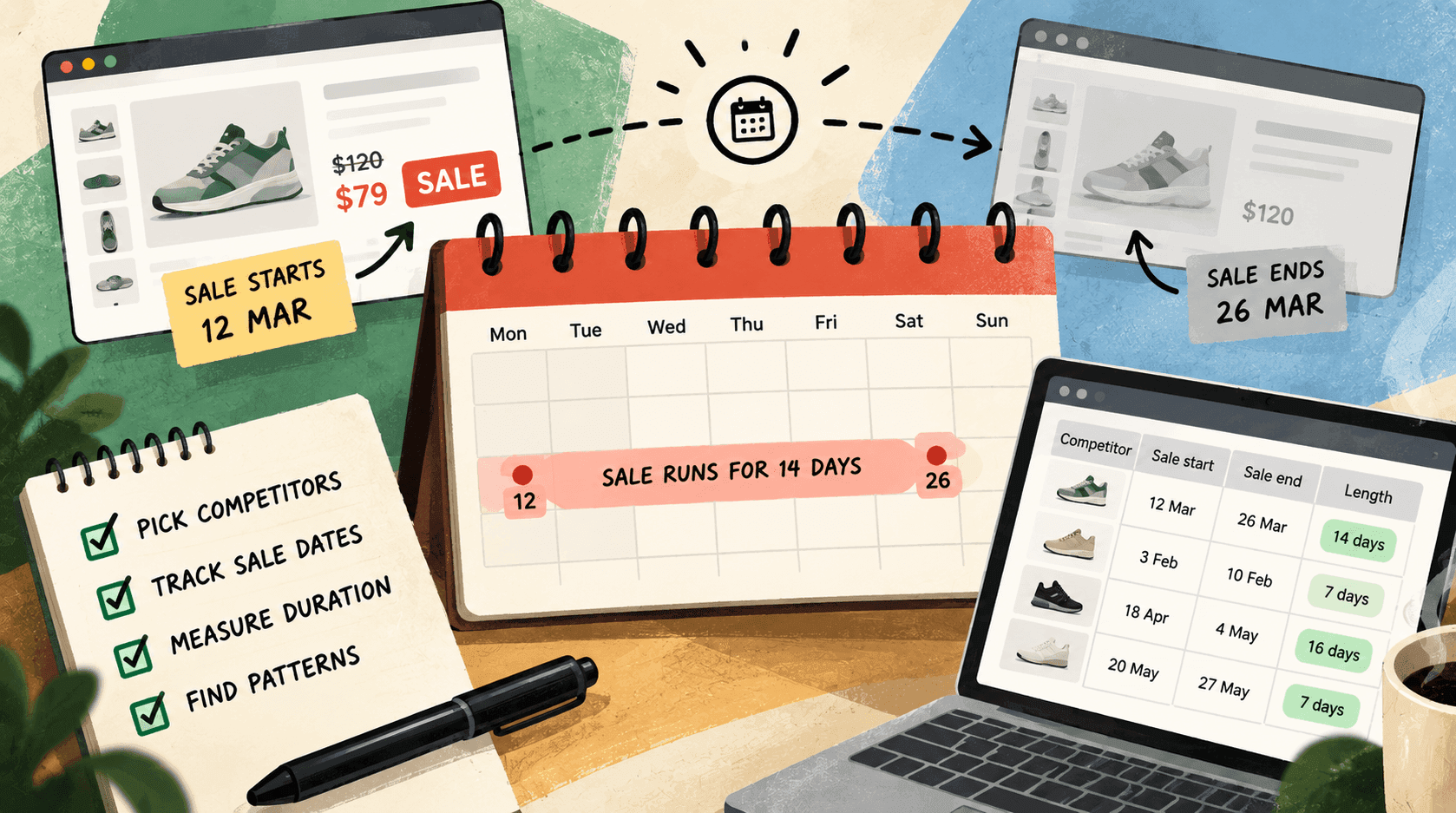
Not one product going down: a group of them moving together. That is a promotion, and it may affect your week.
Suggested threshold: more than about a tenth of a shop's range becoming discounted within a few days. Adjust once you know what normal looks like for that shop — a shop that always has a fifth of its range marked down should not be telling you about it.
3. A competitor's middle price shiftsLink to this section
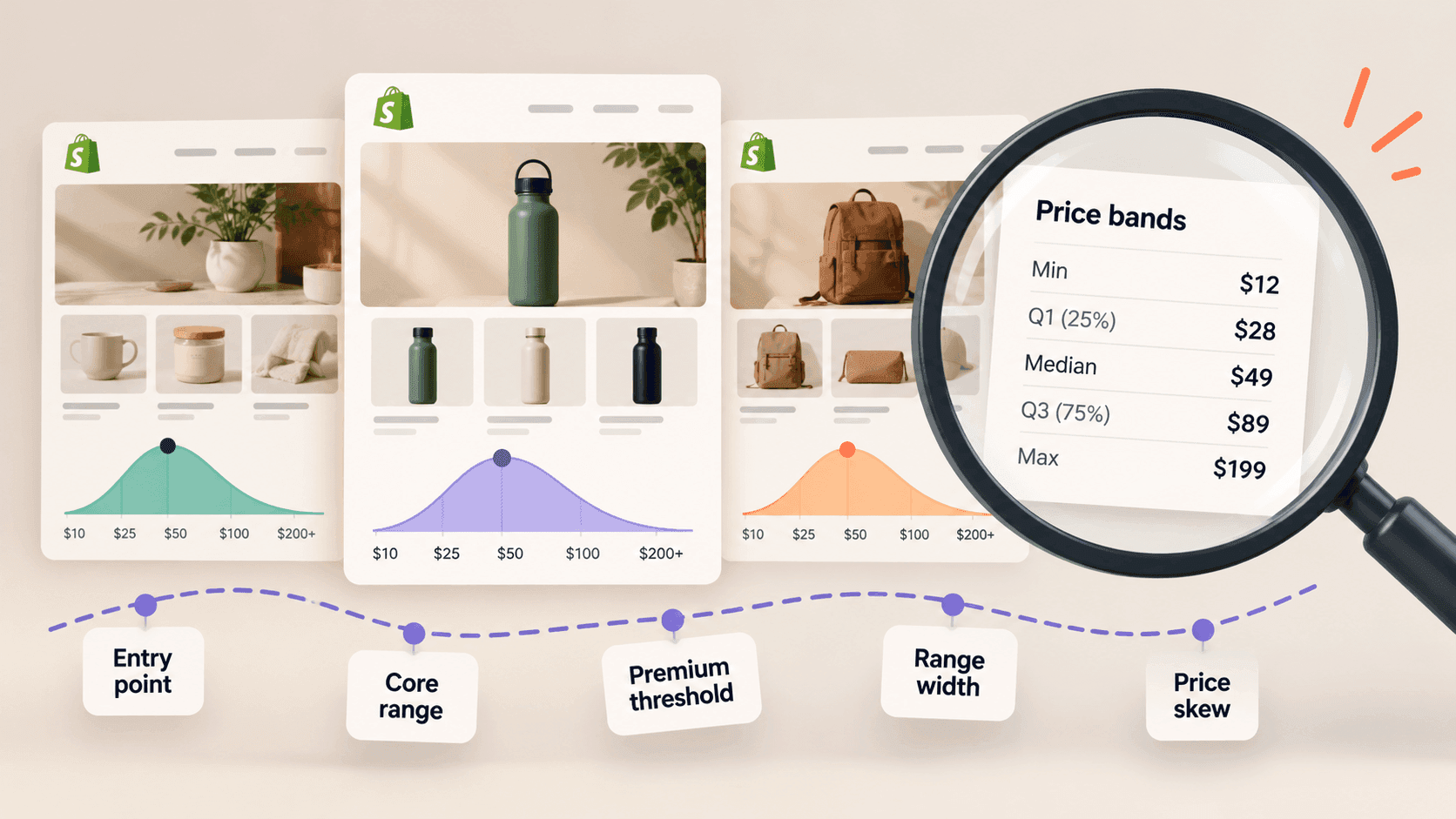
The most strategically important signal and the one nobody sets up, because it is slow. A shop whose middle price drifts up or down over months is repositioning. Reading price bands explains why this beats watching products.
Suggested threshold: a change of roughly 5% or more in the middle price, measured monthly rather than daily.
4. A head-to-head product disappears or comes backLink to this section
A competitor withdrawing a product you both sell is a real event — for them and possibly for your supply too. So is one returning.
Suggested threshold: any appearance or disappearance, short list only.
The four that will bury youLink to this section
Every price change on every product. A shop with several hundred products changes something most days. This setting is why people mute alerts.
Small changes. A 2% move is rounding, a currency adjustment or a supplier cost passed through. It is not news.
Products you do not compete on. Interesting, occasionally. Never urgent.
Anything on a shop you added "just to see". Alerts should be limited to the five to ten shops that genuinely matter — which is fewer than most people pick.
Instant, or a daily summary?Link to this section
Most things should be a daily summary. Very few competitor price changes are worth interrupting a working day.
Instant is justified when the change is on a head-to-head product, or when a competitor starts a sale during a period you are trading hard yourself — a peak week, your own promotion, a launch.
A daily summary is right for everything else. One message, read with coffee, containing the day's movements.
A weekly or monthly summary is right for price band drift, catalogue size and anything you are watching as a trend rather than an event.
A good rule: if you would not get out of bed for it, it does not belong in an instant alert.
Who should receive which alertLink to this section
Alert fatigue is often a routing problem rather than a threshold problem. The same message that is noise to one person is exactly what another needed.
The head-to-head price alerts belong to whoever can actually change a price. If that is the owner, fine; if it is someone who then has to ask the owner, the alert has added a step rather than saved one.
The sale-started alerts belong to whoever plans promotions and whoever buys advertising, because both may want to react the same week.
The catalogue and price-band summaries belong in whatever meeting already reviews trading. They are not an interruption, they are an agenda item, and treating them as an interruption is how they end up ignored.
If only one person is receiving everything, expect the set to get muted. Splitting the four alerts above across two or three people, each getting only what they can act on, is usually the difference between a system that survives a quarter and one that does not.
Reducing false alarmsLink to this section
Three things that cause an alert to fire when nothing happened.
A failed check is not a change. If a shop is briefly unreachable, that is not a product disappearing. Anything alerting you should be able to tell those apart, and should stay quiet on a single failure while telling you about a shop that stays down.
A shop tidying up is not a price move. Bulk edits, re-tagging and re-photographing can touch a lot of products at once without changing what anything costs.
A currency conversion is not a decision. A shop selling in a currency that is not yours will appear to move when exchange rates do.
What an alert can never tell youLink to this section
Why. You will know a competitor dropped prices. Clearance, a land grab, a cash-flow problem, a test — all identical from outside.
Whether it is working for them. You see the price, never the sales.
The promotions that do not touch listed prices. This is the important limit. A discount code, a basket-level offer, a free delivery threshold or an email-only deal changes nothing on the product page, so nothing can alert you to it. A shop can run its biggest promotion of the year in silence, as far as any price alert is concerned.
That last point deserves saying plainly, because it is the one alerting tools tend not to mention: alerts cover listed prices, which is most of the picture and not all of it. Staying on a competitor's mailing list remains the only reliable way to see their coded offers, and it costs nothing.
A sensible starting configurationLink to this section
For a shop watching five competitors:
| Alert | Scope | Delivery |
|---|---|---|
| Price change | 3–5 head-to-head products | Instant |
| Sale started | Whole range, above the shop's normal discount level | Daily summary |
| Product added or removed | 3–5 head-to-head products | Daily summary |
| Everything else | Whole range | Weekly summary |
| Middle price drift | Whole range | Monthly |
Start narrower than you think you want. Widening a quiet alert set is easy; rescuing your attention after two weeks of noise is not.
Where this is going for usLink to this section
Change alerts — new products, price rises and drops, sales starting and ending, items going out of stock — are part of what StoreLenz is being built to do, with the thresholds and the digest-or-instant choice in the hands of the person receiving them, for exactly the reasons above. Alerting is being built rather than finished today; what it does now says which is which.
Related readingLink to this section
- How to track a competitor's price changes
- How to read a competitor's price bands
- How to choose which competitors are worth watching
SourcesLink to this section
- No external sources: this article contains no external fact and no statistic. The thresholds are starting points and judgement, described as such, not measured optima
Written by Cristiano Pinto
shopify store expert