How to
How to write a competitor report a client will accept
The structure, the sourcing discipline and the three sentences that stop a client picking your competitor analysis apart in the meeting.
Published 6 min read
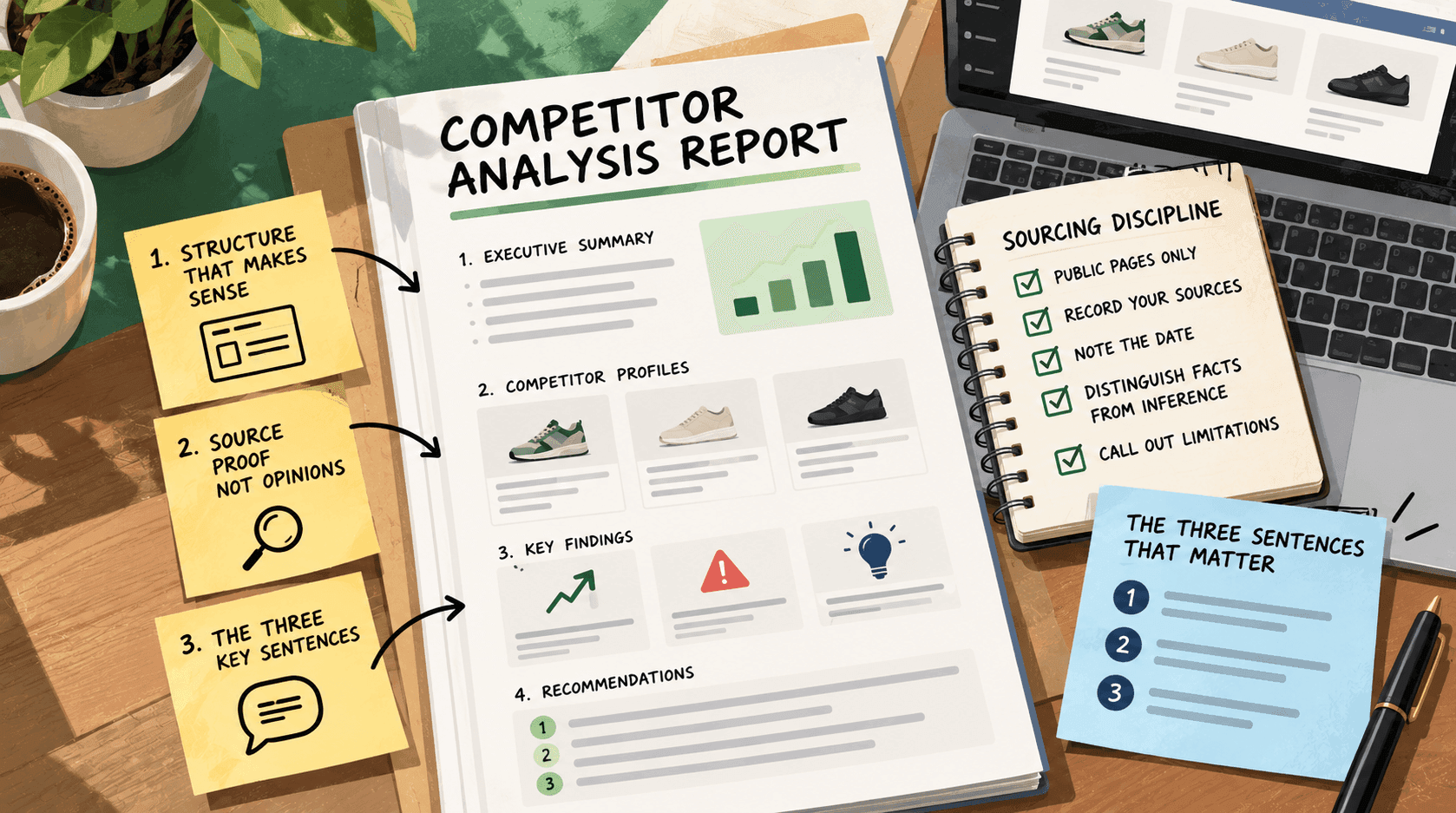
The report that survives the meeting is the one where a client can tell, at a glance, which numbers are counted and which are estimated. Almost every objection you will face — "where did that come from?", "that doesn't match what we know" — is really the same objection: the document presented a guess in the same typeface as a fact. Here is a structure that prevents it, and the habits that go with it.
The principleLink to this section
Separate what you counted from what you modelled, visually and in words.
A counted fact is something you read off a shop's own pages: how many products, what they cost, what is discounted, what appeared last month. A modelled number is anything derived from assumptions: traffic, revenue, market share.
Both belong in a report. Mixing them is what gets you into trouble, because the moment a client disproves one estimate, they distrust every number on the page — including the ones that were solid.
The structureLink to this section
1. One page: what we did and what we could not doLink to this section
Before any finding. Four short paragraphs:
- Scope: which shops, chosen how, looked at on which dates.
- Method: what was read from the shops' own published pages, and what was estimated.
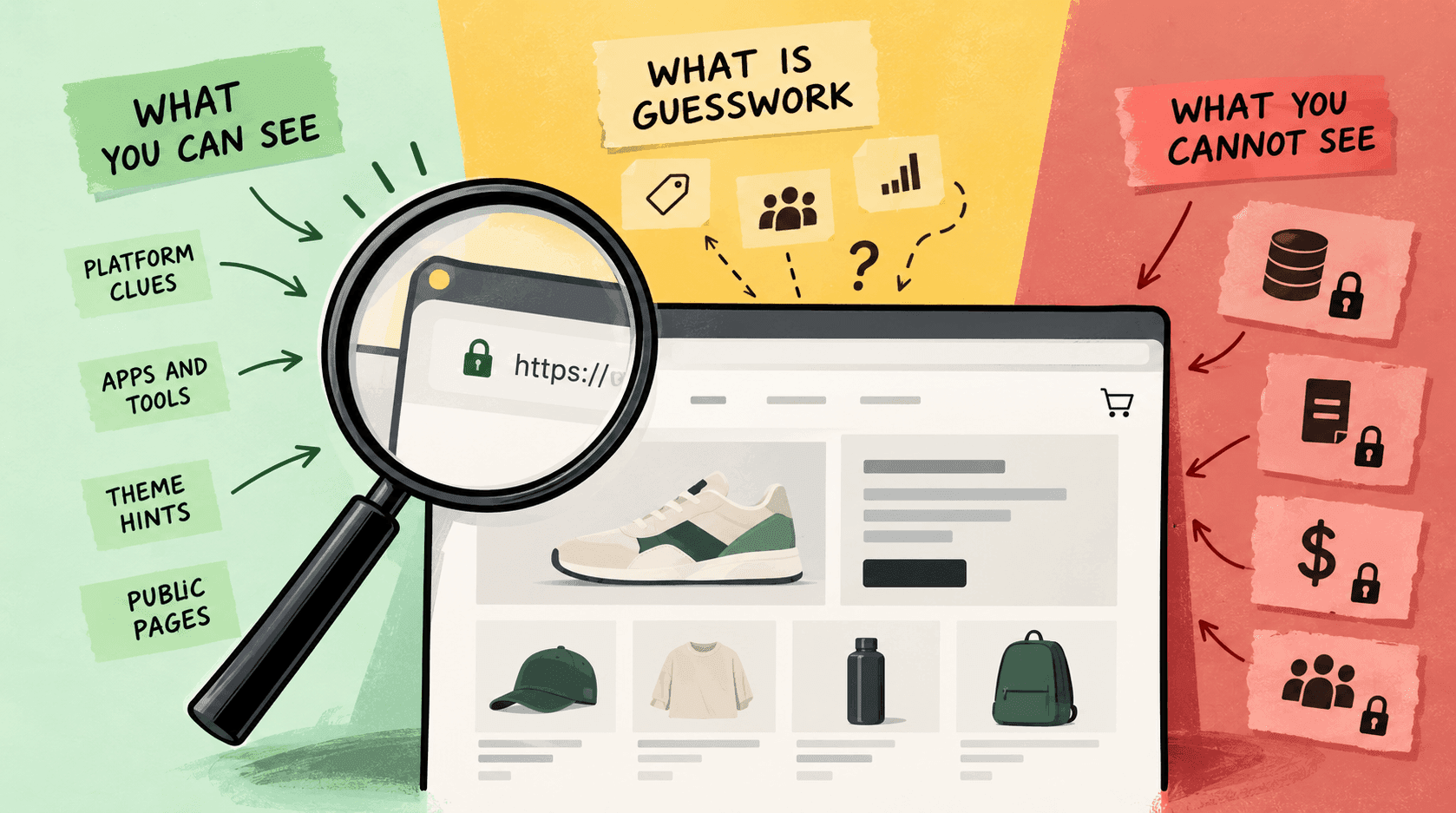
- What we could not determine: costs, margins, marketing spend, stock levels, customer numbers, repeat purchase rate, wholesale and other channels, and any discount not shown on the product page.
- How to read the numbers: counted facts are marked one way, estimates another, and every estimate carries a range, a date and a confidence.
That third paragraph is the one that changes meetings. A client who reads it up front stops expecting answers you cannot give, and starts treating the limits as evidence of rigour rather than gaps. The full inventory of what is and is not visible is worth lifting into your own template.
2. The comparison table: counted facts onlyLink to this section
One row per competitor. Products, variants, price range, share of range discounted, products added in the last month, features visible, platform. Every cell a fact, every column dated.
This table is the backbone of the report. It is completely defensible, a client can verify any cell in two minutes, and it usually answers more of their real questions than the estimates do.
3. Scale: estimates, clearly markedLink to this section
A separate section, never a column in the table above.
Estimated scale (modelled — see method). Competitor A appears to be roughly three times the size of Competitor B. Absolute figures are not reliable enough to state for shops of this size. Low confidence. Based on data as of 23 September 2026.
Comparing two shops modelled the same way is far more defensible than either figure alone, because the shared assumptions largely cancel out. Say that in the report; it is the sentence that turns a weak number into a useful one. The fuller explanation is worth linking or footnoting.
4. What changed: the section that justifies the feeLink to this section
Snapshots describe. Changes persuade.
"Since June, Competitor A has added a subscription option, raised their middle price band by roughly 8%, and reduced their discounted range from about a quarter to under a tenth. (Example figures.)"
Change is the most honest signal available from outside, because you are comparing a shop to itself rather than to an assumption. It is also the part a client cannot get by browsing the shops themselves for ten minutes, which is precisely why it is worth paying for.
5. Three sentences per competitorLink to this section
What kind of business this is; what they appear to be betting on; what it means for the client. No more. A client reads this section and skims the rest.
6. Recommendations, separated from findingsLink to this section
Findings are what you observed. Recommendations are your judgement. Putting them in the same section invites a client to reject a solid finding because they disagree with the advice attached to it.
The sourcing disciplineLink to this section
Four habits, and they are not optional if you want the report to survive scrutiny.
Date every figure. In the cell, not in a footnote. "£42 (23 Sep 2026)". Competitor data ages in weeks.
Say "listed price", not "price". Discount codes and basket offers are invisible from outside, so the price you recorded is the shelf price and nothing more. One word protects you.
Attach a source to every number. Even if the source is "read from the shop's own product list on 23 September". A number with no provenance is the one that gets questioned.
Never write a single figure for something you estimated. A range plus a confidence word. "Somewhere in the low tens of thousands of monthly visitors (low confidence)" is honest and survives; a precise figure invites someone to check it and be right.
What to do when the client wants a number you do not haveLink to this section
They will ask. "Just give me a rough revenue figure."
The answer that works is not a refusal — it is a substitution:
"A revenue figure for a shop this size would be a guess with a very wide margin, and if I give you one it will end up in a board pack as a fact. What I can give you, and stand behind, is: they list 140 products between £18 and £65, added 11 last month, and currently discount 9 of them. On scale, they look meaningfully larger than Competitor B and smaller than Competitor C. (Example figures.)"
That is more useful than the number they asked for, and it is the answer that protects you six months later when somebody checks.
If they insist, give the range with the confidence label and put the method in a footnote. Never give the single figure.
The test before you send itLink to this section
Read the report as the client's most sceptical colleague. For every number, ask: could I verify this in two minutes, and if not, does the document say so?
If a figure fails both halves of that question, either source it or take it out.
What a good report cannot doLink to this section
It cannot tell the client whether a competitor is profitable, whether they are growing sustainably, or what they plan to do next. Those live behind the shop window. A report that implies otherwise is a report that will eventually be wrong in public.
The honest deliverable is a clear, dated description of several businesses, the changes between one look and the next, and your judgement — labelled as judgement. That is genuinely valuable, and it is what a client can act on.
Related readingLink to this section
- What you can and cannot learn about a store from outside
- How to estimate a Shopify store's revenue — and how wrong it can be
- A competitor research checklist you can run in 30 minutes
SourcesLink to this section
- No external sources: this article contains no external fact and no statistic. It is method, and every figure in the sample paragraphs is labelled as an example
Written by Pinto Arkad
I love shopify