How to
What to do when a competitor undercuts your price
Before you match a competitor's price, find out whether the cut is real, how long it lasts and which products it covers. Usually the answer is not to match it.
Published 6 min read
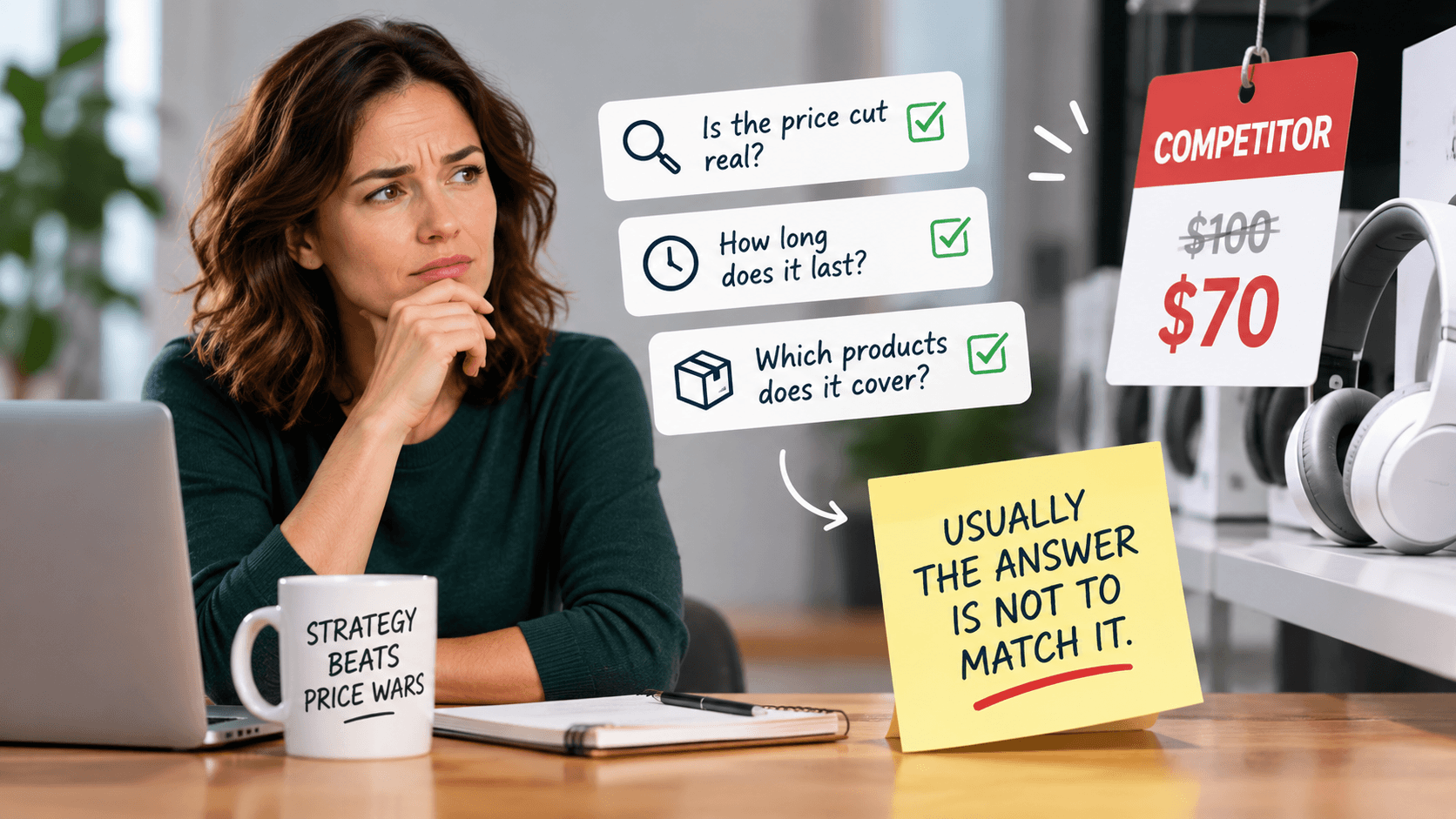
Answer five questions before you change anything. Most price cuts that feel urgent turn out to be a temporary promotion on a few products, a permanent markdown that was never a cut at all, or a competitor buying share with money they will not keep spending. Matching immediately gives away margin you may never get back, and it is very hard to undo — customers notice a price going up.
Question 1: Is it real?Link to this section
A lower price on a product page is not always a price cut.
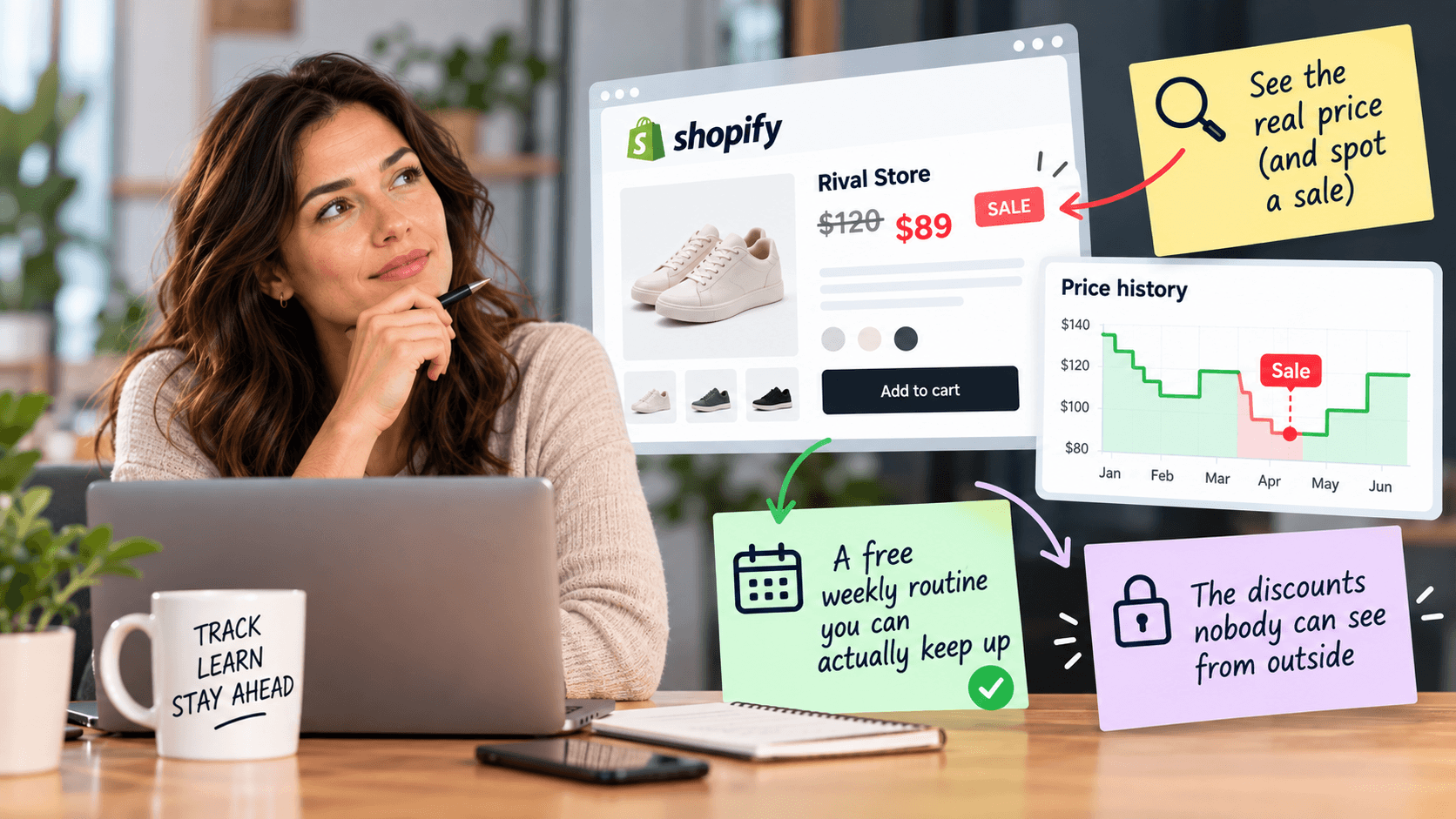
It may be a promotion. Shopify stores show a discount by keeping the original price alongside the new one — the crossed-out figure — so if that is present, you are looking at a markdown the shop itself is treating as temporary. Promotions end.
It may be permanent theatre. Some shops leave that crossed-out price in place indefinitely, so a product appears discounted every day of the year. Their "sale price" is simply their price, and matching their headline discount means cutting below them for no reason. How to tell the difference takes about a minute if you have last month's prices, and is impossible from a single visit.
It may not have changed at all. Check what you recorded previously. People frequently "discover" that a competitor is cheaper on a product where they have always been cheaper.
Question 2: How much of their range is it?Link to this section
One product going down is not a price war. Open their whole product list and count how many items are discounted compared with a month ago.
- A handful of products: clearance, or an end of line. Ignore it.
- A category: a deliberate push in one area. Worth a response in that area only.
- Most of the range, suddenly: a real promotion. Time-limited, almost always.
- Most of the range, permanently: that is their pricing model, not an attack, and you should stop treating it as
news.
Reading their price bands answers this faster than checking products one by one, and it will also show you whether their middle price has actually moved — which is the thing that matters strategically.
Question 3: How long has it lasted?Link to this section
A price that has been low for three days is a promotion. A price that has been low for three months is a repositioning.
You can only answer this if you have been recording, which is the argument for keeping a dated price log before you need one. If you have nothing, start today and wait two weeks before reacting to anything but a genuine emergency. Two weeks of patience costs far less than a permanent margin cut.
Question 4: Are you comparing the same thing?Link to this section
Almost never, in practice. Before concluding you are undercut, check:
- Delivery. A £3 lower price with £5 delivery is not lower.
- What is included. Quantity, size, accessories, warranty, returns window.
- Returns. Free returns cost real money and buyers value them.
- Availability. A cheaper product that is out of stock is not competing with you this week.
- Speed. Next-day against two weeks is a different product to most buyers.
Write your total offer and theirs side by side. Quite often the gap is smaller than the shelf price suggests, and occasionally it runs the other way.
Question 5: Can you see why?Link to this section
You cannot see their costs or margins — that is genuinely invisible and no tool will change it. But you can often see the shape of what is happening:
- A lot of stock unavailable, then a price drop: they are clearing.
- A price drop alongside a stream of new products: they are making room.
- A price drop with no other change: possibly a deliberate share grab, possibly pressure you cannot see.
- A price drop that follows yours: they are watching you too.
None of this is proof. It is context, and context is what stops you reacting to a clearance as though it were a strategy.
The responses, in order of preferenceLink to this section
Do nothing. The right answer far more often than it feels. Most promotions end, and your customers mostly are not comparing line by line.
Improve the offer instead of the price. Free delivery over a threshold, a better returns promise, a bundle, faster despatch. These cost less margin than a price cut and are harder for a competitor to copy quickly. They also do not teach your customers to wait for discounts.
Match on the few products where it matters. Your genuinely head-to-head items — the three to five where a buyer would put the two products side by side. Not the whole range.
Cut properly, and say why. If you conclude the market has moved, move deliberately: a considered new price, not a panicked match, communicated as a decision rather than a sale.
Go the other way. Occasionally the right response to a competitor going cheap is to go clearly upmarket — better photography, better packaging, a better guarantee — and let them have the price-sensitive buyers. This is a real strategy and it is chosen far less often than it should be.
What you must not doLink to this section
Do not match a price you cannot sustain. Prices are much easier to lower than to raise, and a match you regret in two months is worse than the original problem.
Do not assume they can afford it. You cannot see their margins. A competitor undercutting you may be losing money on every sale — that is not a race worth entering just because they entered it.
Do not react to a single snapshot. Almost every bad pricing decision in competitor research comes from one look at one page on one day.
The habit that makes all of this easyLink to this section
All five questions are trivial to answer if you have a dated record of competitor prices, and impossible if you do not. That record is the whole game, and building it by hand is the part that lapses — which is exactly what StoreLenz is being built to keep up for you, so that when a price moves you already have the history to judge it. Price tracking and alerts are being built rather than finished today; what it does now says which is which.
Related readingLink to this section
- How to tell whether a store is really running a sale
- How to read a competitor's price bands
- How to track a competitor's price changes
SourcesLink to this section
- Shopify Help Center, Setting sale prices for products (a shop sets a compare-at price and the theme shows both prices with a sale badge) — https://help.shopify.com/en/manual/products/details/product-pricing/sale-pricing — read 2026-09-22
- No statistic about margins, price elasticity or typical retail behaviour appears in this article; the guidance is
commercial judgement, described as such
Written by Cristiano Pinto
shopify store expert