How to
How to find every Shopify competitor in your niche (free methods)
Six free ways to discover the shops competing with you, including the ones you have never heard of, and how to tell a real competitor from a lookalike.
Published 6 min read
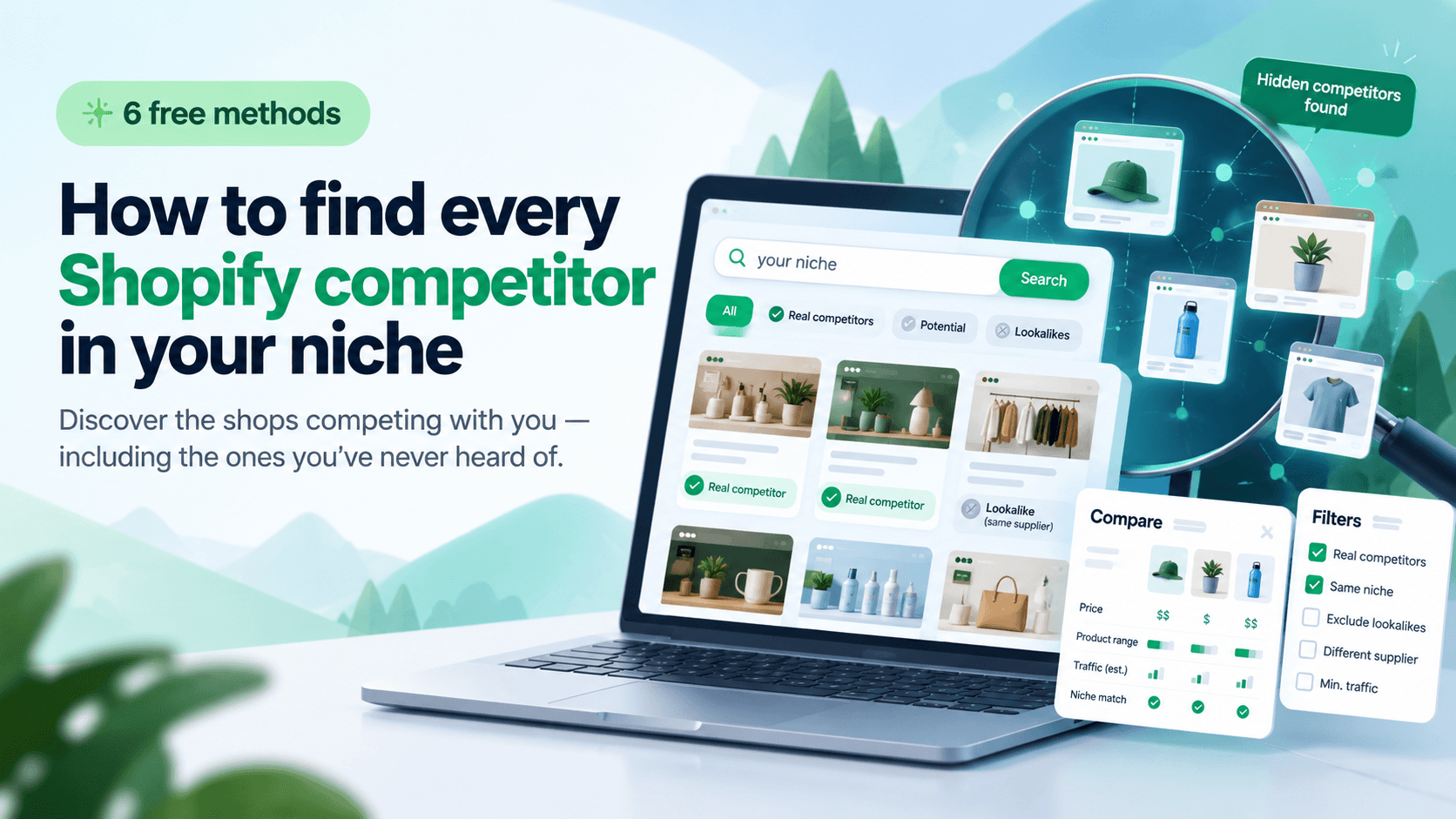
The fastest free method is to search for what you sell the way a customer would, and write down every shop on the first two pages. Then repeat it with four more phrasings, add the shops your suppliers and your customers mention, and you will have a longer list than you expected — including the ones you had never heard of, which are usually the interesting ones. Here are six methods, and how to tell which of the names are genuinely competitors.
This is about finding them. Deciding which ones deserve your attention afterwards is a separate question, and the short answer is that five to ten is the right number to actually watch.
1. Search the way your customer searchesLink to this section
Not your product name. The words a person uses when they do not yet know your brand exists.
For each of five or six phrasings — "hand poured soy candles", "candles for small flats", "candle gift set uk" — write down every shop on the first two pages of results. Include the ones you think are too small or too big; you are collecting, not judging.
Why two pages: the first page is dominated by whoever is best at search, which is not the same as whoever is taking your customers.
2. Search the way a shopper browsesLink to this section
Repeat the exercise on the platforms your customers actually use — the social apps, the marketplaces, the recommendation sites for your category. Different shops surface in each, and a shop that is invisible in a search engine can be the biggest name in your category on one social platform.
This is the method that most often turns up a competitor the owner had genuinely never heard of.
3. Ask your own customersLink to this section
Direct, free, and consistently the most accurate.
Add one optional question to your post-purchase email: "Where else did you look before buying from us?" A handful of answers will tell you more about your real competitive set than a week of searching, because it comes from the people whose decision actually matters.
Your customer service inbox is the same source. Anyone who mentions another shop by name — in a comparison, a complaint, a returns request — has told you something.
4. Look at who your suppliers sell toLink to this section
If you resell, your suppliers' other stockists are direct competitors and the supplier usually publishes them as a "where to buy" or stockist list. If you make your own products, the brands sharing your manufacturers, materials or trade shows are the nearest equivalent.
Trade directories, industry associations and the exhibitor list of any trade show in your category are public and free.
5. Follow the shops you already knowLink to this section
Once you have a few names, they lead to more:
- Who do they mention? Collaborations, "as featured in", stockist lists.
- Who mentions them? Search their brand name and read what comes back — round-ups and "best of" lists in your category are effectively pre-made competitor lists.
- Where do their customers go next? Reviews and forum threads that compare shops are written by exactly the people you are trying to understand.
6. Public shop directories, carefullyLink to this section
There are public lists of Shopify stores, searchable by keyword or category. They can be a genuine source of names you would never otherwise find.
With a real caution. When we tested store lookups against a public directory of shop addresses in September 2026, a noticeable share of the listed addresses were no longer running the kind of shop they were listed as — in one case a shop selling one thing had become a business in a completely different trade.
So treat any directory as leads to verify, never a list to use. Open each one. Check it is trading, check it is still in your category, and check it still runs on Shopify — which takes ten seconds.
Sorting the listLink to this section
You will now have thirty or forty names. Most are not competitors.
Three quick disqualifiers:
- Wrong customer. They sell something similar to a different kind of person.
- Wrong price band. More than roughly double or less than half your average price is a different decision for the buyer.
- Not trading. No recent products, stale pages, most things unavailable.
Two quick promotions to the top:
- They appeared in more than one method. A shop that turned up in search and was named by a customer is almost certainly real.
- They are roughly your size and moving. More useful than the category giant.
Then narrow to the five to ten you will actually watch — how to choose them is the next step, and going wide here only pays off if you go narrow afterwards.
What no method can doLink to this section
Find every competitor. A shop with no search presence, no social following and no directory listing can still be taking your customers through word of mouth or a marketplace. Accept that the list is incomplete.
Find the ones that do not exist yet. In a category with low barriers, a meaningful competitor can appear in a quarter. This is why the list needs re-checking rather than building once.
Tell you who is actually winning. You have names, not performance. Everything about how well these shops are doing has to be inferred from what they publish — and much of it cannot be known at all.
Include the competitor that is not a shop. A marketplace, a subscription service or a large retailer's own range may take more of your customers than any independent shop on your list.
Do this quarterly, not onceLink to this section
Markets move. Shops close, launch, rebrand and reposition, and a list built once is wrong within a year. A half-hour refresh every quarter — re-run two searches, re-check the existing names are trading, add anything new — keeps it honest.
That refresh is also when you drop the shops that turned out not to matter, which people almost never do.
After the listLink to this section
Once you know who they are, the work is watching what they do over time rather than what they look like today. That is what the practical guide to competitor analysis covers, and it is what StoreLenz is being built to do for the shops you name — read them on a schedule and tell you what changed. What it does now says which parts are built and which are coming.
Related readingLink to this section
- How to choose which competitors are worth watching
- Shopify competitor analysis: a practical guide
- How to tell if a website is built on Shopify
SourcesLink to this section
- Shopify Help Center, Finding and submitting your sitemap (every store publishes one, which is how a shop's activity can be checked) — https://help.shopify.com/en/manual/promoting-marketing/seo/find-site-map — read 2026-09-22
- Our own testing of store lookups against a public directory of shop addresses, September 2026, where a number of listed addresses were no longer running the kind of shop they were listed as
Written by Soneth Martins
shopify store manager