Explainer
The order-number trick: estimating a Shopify store's sales, and its limits
Shopify order numbers count up by one. That makes a rough order count possible — and it costs two real purchases and carries limits most people never mention.
Published 6 min read
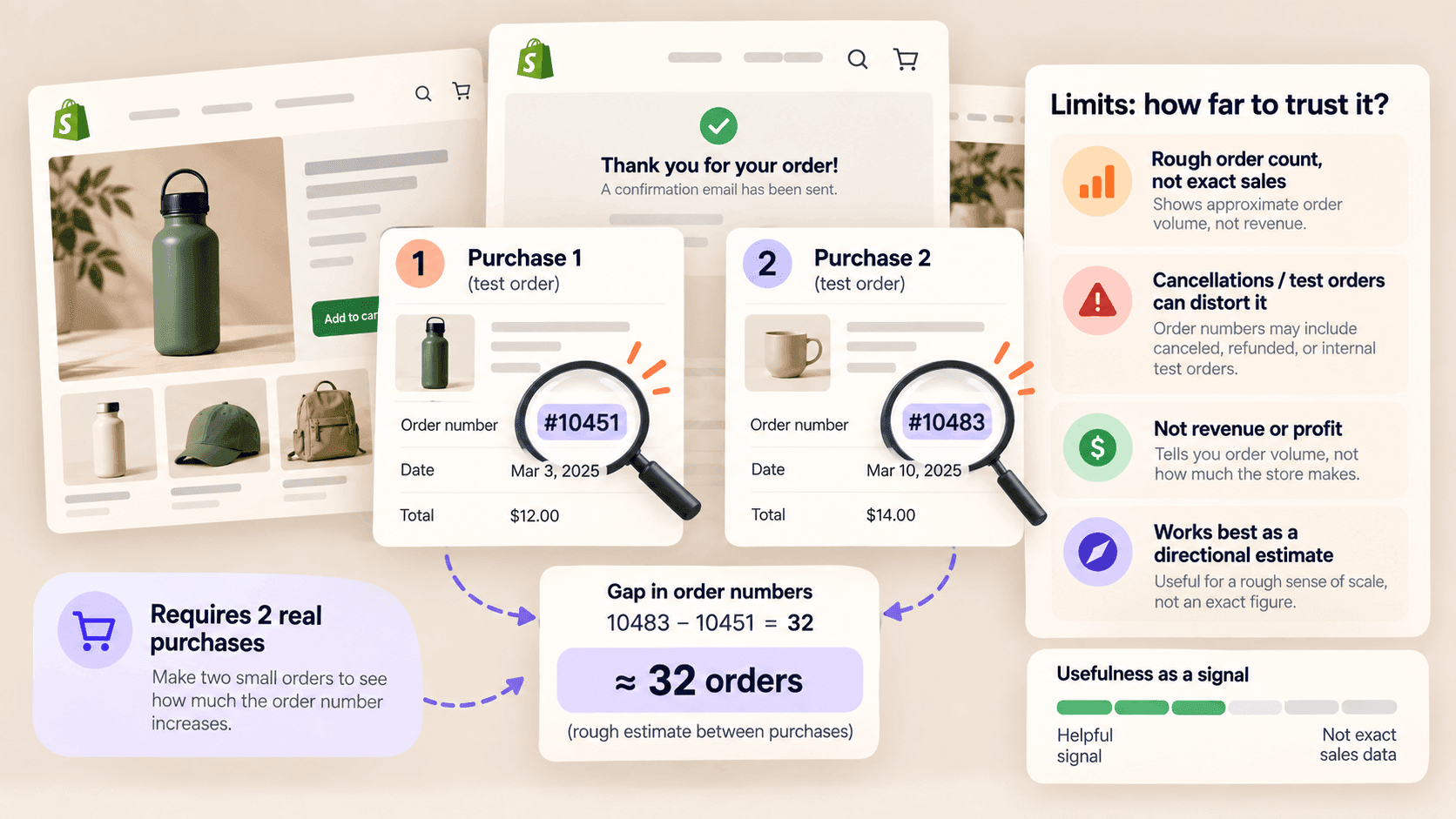
Shopify gives every order a number that counts up by one. Buy something today, buy something four weeks later, and the gap between your two order numbers is roughly how many order numbers that shop issued in between. It is the most-repeated trick in competitor research, it genuinely works, and almost nobody mentions that it costs two real purchases and counts something slightly different from sales.
Why it worksLink to this section
From Shopify's own help pages: "By default, your first order ID is given the format #1001", and "Orders after that are incremented by 1 for each new order." Crucially, the same page says "You can't change the number that your orders begin at (1001)" — a merchant can only change the prefix or suffix, replacing or deleting the # with "any characters A-Z, 0-9, or symbols".
So the number itself is a running count the shop cannot reset or fake. SL-1042-EU and #1042 carry the same
- That is the whole basis of the technique, and it is why it survives while most "tricks" do not.
The methodLink to this section
- Buy something small from the shop. It has to be a real order — this is the part people skip past. Note the order number on the confirmation.
- Wait a defined period. Four weeks is a reasonable unit. Note the exact dates; the period is half your answer.
- Buy something small again. Note the second order number.
- Subtract. The difference is the number of order numbers issued in that period.
- Divide by the days to get a daily rate, if you want one.
Strip the prefix and suffix first. If the numbers read SL-1042-EU and SL-1298-EU, you are comparing 1042 and 1298: 256 order numbers in the period.
What you have actually measuredLink to this section
Not sales. Order numbers issued. The difference matters more than it sounds, and this is where every confident version of this article goes quiet.
A number can be consumed by things that are not a completed sale:
- Orders that were later cancelled or refunded. They still took a number.
- Orders from other channels. A shop selling in person, on a marketplace or through wholesale may be putting those orders through the same system.
- Test orders. Shops place them, especially around a redesign or a new payment method.
- Draft orders and invoices sent to customers.
We have not measured how many numbers a typical shop consumes without a completed sale, and we are not going to put a percentage on it. The honest position: your figure is an upper bound on orders, not a count of them.
Turning a count into revenue, and why the wheels come offLink to this section
The obvious next step is to multiply your order count by an average order value. This is where an estimate that was merely rough becomes one that can be out by a factor of several.
You do not know their average order value. You can guess it from their listed prices — but the real figure is lower, because discount codes and basket offers are invisible from outside, and it may be higher, because bundles and upsells raise it. You are multiplying an upper bound by a guess.
So if you do it at all, write it as a range with a confidence label, exactly as you would any other estimate. Why one precise number is a red flag applies here more than anywhere.
Where the count genuinely is useful:
- Order of magnitude. Tens of orders a day is a different business from hundreds. That much the method supports.
- Change over time. Repeat it a quarter later and the direction is far more trustworthy than either absolute figure, because whatever inflates the count is probably inflating both.
- Relative size. Run it on two shops over the same period and the comparison is more defensible than either number alone.
The cost, stated plainlyLink to this section
- Two real purchases, plus delivery, per measurement period, per shop. For a handful of competitors and a quarterly measurement, that is a real line in your budget.
- Your time, and a delivery you probably did not want.
- It only works from the moment you start. There is no way to get a historic reading.
That cost is why this is a technique for a specific question — roughly how big is this one shop? — rather than a routine. For ongoing monitoring, the things a shop publishes for free (its catalogue, its prices, what it launches) tell you more per hour.
Doing this decentlyLink to this section
It involves buying from a competitor, which is ordinary — you are a customer, and it is the oldest research method there is. Two things keep it that way:
Buy something you will actually keep. Placing an order and cancelling it wastes a real person's picking, packing and payment fees, and it corrupts your own measurement. Buy the cheapest real thing and keep it.
Do not abuse their checkout. Starting a checkout to read a number without completing it, or repeatedly abandoning carts, is a cost to them and not something we would write a method for. Where the line sits in competitor research covers this more fully. The short version: reading what a shop publishes is fine; making them absorb a cost to satisfy your curiosity is not.
When not to botherLink to this section
- For a small shop. The gap over four weeks may be a handful of numbers, and the noise swamps the signal.
- When you only need a tier. If "are they bigger than us?" is the question, their product count, price range and launch rate answer it for nothing.
- When you need it to be right. It is an upper bound built on an assumption. Do not put it in a client document as a sales figure; the honest way to present scale is a range with a date and a confidence.
What we do insteadLink to this section
StoreLenz does not use this method. It reads what shops publish — products, prices, what changed — and shows scale as a range with a confidence label, saying so when there is not enough signal to model a shop at all. What it does today is written out plainly, including the parts still being built.
The order-number trick is a legitimate piece of arithmetic on a number Shopify genuinely publishes. It is just a much blunter instrument than the confident articles about it suggest.
Related readingLink to this section
- How to estimate a Shopify store's revenue — and how wrong it can be
- Are Shopify revenue checkers accurate?
- Is it legal to monitor competitor Shopify stores?
SourcesLink to this section
- Shopify Help Center, Adding business settings for your store — "By default, your first order ID is given the format #1001"; "Orders after that are incremented by 1 for each new order"; "You can't change the number that your orders begin at (1001)"; the prefix may be deleted or replaced "with any characters A-Z, 0-9, or symbols" — https://help.shopify.com/en/manual/intro-to-shopify/initial-setup/setup-business-settings — read 2026-09-28
- No figure is given for how many order numbers are consumed without a completed sale, because we have not measured it
Written by Soneth Martins
shopify store manager