Explainer
Why small stores produce no revenue estimate at all
Why estimating tools go blank on smaller shops, why a chart showing zero visitors is usually wrong, and how to size up a small competitor without an estimate.
Published 7 min read
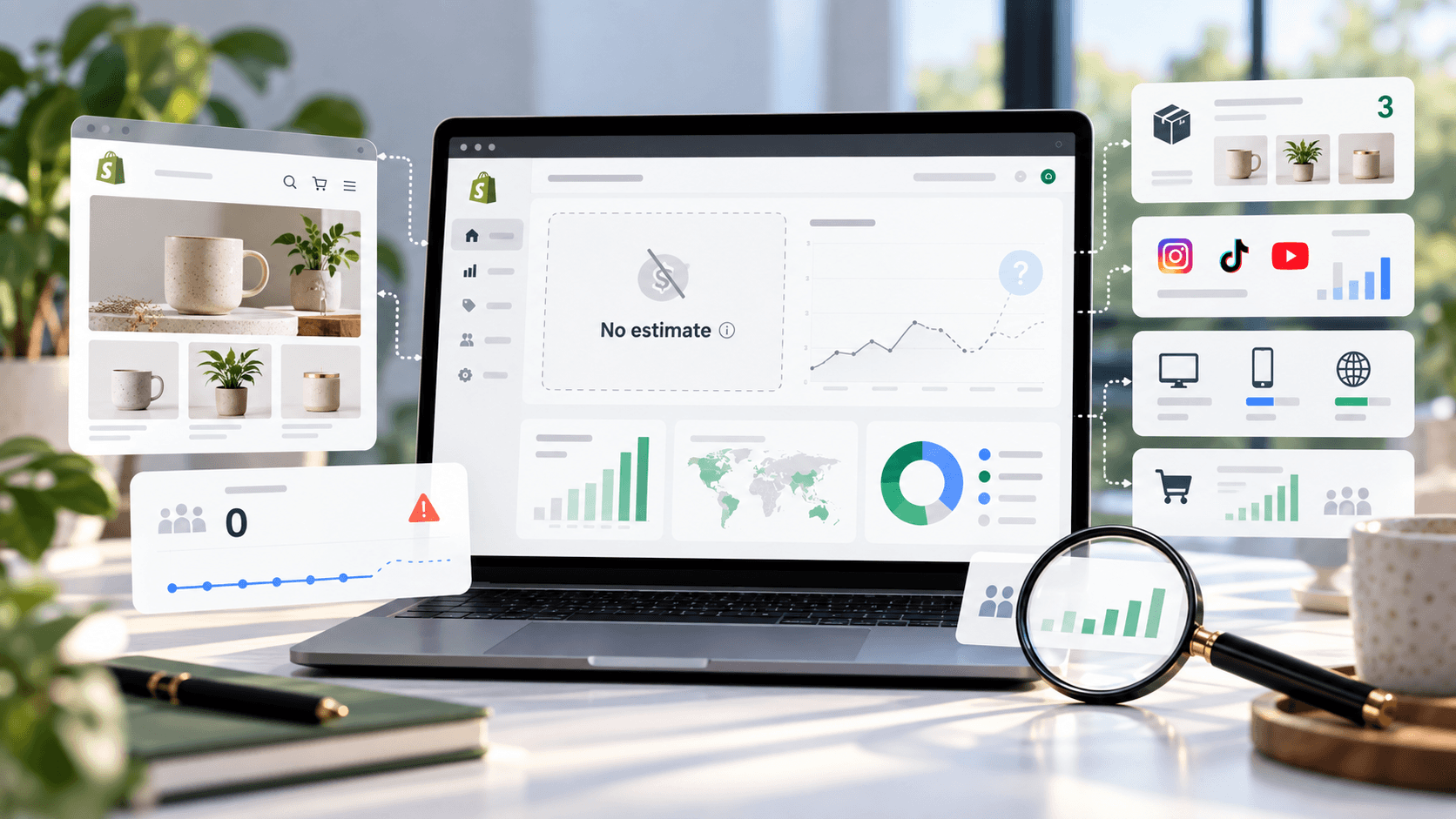
Because there is nothing to work from. Revenue estimates are built out of an estimated visitor count, and below a certain size a shop does not produce enough public signal for anyone to estimate that count. The honest output at that point is no number at all. A tool that shows you a confident figure for a shop with forty products is not better informed than one that shows you nothing — it is just less willing to admit the gap.
What we found when we tested itLink to this section
We ran real store lookups against a set of public shops in September 2026. Two results are worth passing on.
For shops with a few dozen products, the revenue estimate failed every time we tried it. Not a low number — no answer at all. The estimating step simply could not return one.
And for those same smaller shops, the traffic figures came back as zero visits in every month, with no countries and no traffic sources listed. These are shops with real customers. They are not getting zero visitors. They are below the level at which the measurement works.
(That is an observation from testing a handful of shops, not a study. It tells you how the tooling behaves. It is not a statistic about small shops in general and we are not going to present it as one.)
Why "zero visitors" is the most misleading number in this whole fieldLink to this section
There is a large difference between we measured nothing and there was nothing, and most charts draw them identically — as a flat line along the bottom.
Visitor estimates are built by watching a sample of people browsing and scaling up. If a shop's audience is small enough that nobody in the sample happened to visit it, the estimate is zero. That is a statement about the sample, not about the shop.
So when you see a shop with a functioning checkout, a stream of new products and an active mailing list showing a flat zero traffic line, believe the products. Read zero as "unknown". A chart that cannot distinguish the two is not telling you what it appears to be telling you, and we would rather answer "no data" than draw that line.
Why the threshold exists at allLink to this section
There is no published cut-off, and any specific one would be invented, so here is the honest shape of it rather than a number.
A visitor estimate needs enough observed visits to separate a real pattern from noise. A shop that is genuinely busy produces plenty. A shop turning over a respectable amount from a loyal, repeat audience may produce very few, because the number of people is modest even when the business is fine.
This is the part that surprises people: failing to produce an estimate is not a judgement about a shop's health. A shop with three hundred devoted customers who buy every month can be a good business and still be invisible to estimation. So can a shop selling something expensive and rare. "No estimate" means "too small to measure from outside", not "too small to matter".
What to do instead, when the estimate is blankLink to this section
This is the useful half. For a small competitor the countable facts are better evidence than a modelled number would have been anyway, because at this size they are the whole business.
- Count the products, and count them again in a month. A small shop's launch rate is the clearest signal it
sends. Ten new products in a month from a forty-product shop is a business investing; none in six months is a business coasting. How to read what a shop has just launched covers this.
- Read the price range. A small shop's pricing tells you who it is for more reliably than any traffic figure.
- Watch what is marked down and how often. Frequent discounting on a small range usually means stock that is
not moving.
- Look at how much of the shop is maintained. Fresh photography, written descriptions, a current blog, real
pages — these cost time, and a shop spending time on them is a shop someone is working on.
- Check how long they have been going. A shop's own pages and its sitemap show how long content has existed. A
small shop that has been steady for four years is a different competitor from one three months old.
- Count the reviews, carefully. Review numbers are public and give a floor on order volume. Only a fraction of
buyers ever review, and that fraction is unknowable, so this is a lower bound and never a total.
None of that yields a revenue figure. Together it tells you what you actually wanted: whether this competitor is growing, and whether they are a threat.
What to write downLink to this section
If you are putting a small competitor in a document, the honest line is the useful one:
"No reliable revenue estimate is available for a shop of this size. Counted instead: 44 products, 6 added in the last month, prices from £18 to £65, 9 products currently discounted. Checked 23 September 2026."
That paragraph is more defensible than any figure, and a client or colleague can verify every part of it.
What none of this tells you eitherLink to this section
The counted facts above are solid, and they still leave the important things unknown.
They do not tell you whether the shop is profitable. A small shop launching constantly may be investing wisely or burning through savings. Activity is not health.
They do not tell you how much of the business is online. A small shop can do most of its trade at markets, in a physical shop, through wholesale or on a marketplace. The website may be the smallest part of it, and none of that shows up.
They do not tell you who is behind it. A forty-product shop can be one person working evenings or a side project of a much larger company. Same shop window, entirely different competitor.
So even with a page of counted facts, the honest verdict on a small competitor is usually a description rather than a judgement. That is not a failure of research. It is what the available information supports.
The general ruleLink to this section
Be suspicious of any tool that always has an answer. Data has gaps, and a system that never shows one is filling them. On this specific question our position is fixed: where there is not enough public signal to model a shop, StoreLenz says so rather than inventing a number, and where there is, the answer is a range with a confidence label. What the product does today is written out plainly.
Related readingLink to this section
- How to estimate a Shopify store's revenue — and how wrong it can be
- How to see what a competitor has just launched
- Shopify competitor analysis: a practical guide
SourcesLink to this section
- Our own testing of store lookups, revenue estimates and traffic data across a set of real public shops, September 2026. Described qualitatively; the sample is far too small for a percentage and none is given
- Shopify Help Center, Finding and submitting your sitemap (every store publishes one, which is how content age can be checked) — https://help.shopify.com/en/manual/promoting-marketing/seo/find-site-map — read 2026-09-22
Written by Pinto Arkad
I love shopify