How to
How to tell if a Shopify store is dropshipping
Four checks that take about five minutes, what each signal is really worth, and why dropshipping tells you something useful about a competitor rather than something bad about them.
Published 7 min read
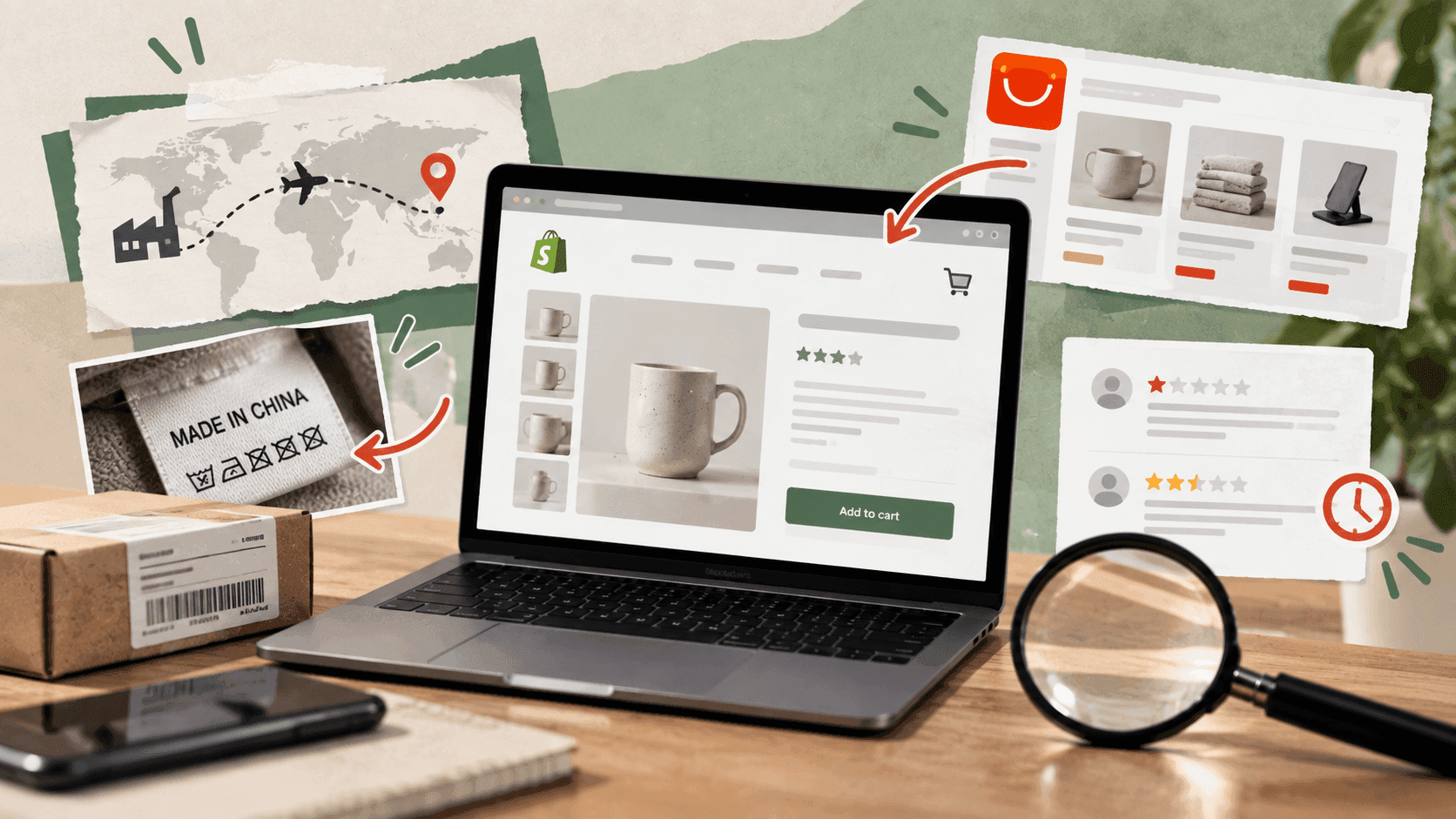
No single check proves it, so look for several signals agreeing. The fastest three: open the shop's returns policy and see where returns go, look at its product list for a vendor name and a suspicious run of identical creation dates, and run one product photograph through a reverse image search. A shop sending returns to another country, selling unrelated categories, and using photographs that appear on a dozen other sites is almost certainly not holding its own stock.
And one thing first, because most articles on this question get it wrong: dropshipping is a normal, legal way to run a shop. Plenty of good businesses use third-party fulfilment for some or all of their range. What follows is about understanding a competitor's economics, not about catching anyone out.
Check 1: the returns policy (30 seconds)Link to this section
The most informative page on any shop, and almost nobody looks at it.
Shopify stores publish their policies at standard addresses. Add /policies/refund-policy to the shop's address — we confirmed this loads a real returns policy on two unrelated shops on 2026-09-30. Try /policies/shipping-policy too.
What to read for:
- Where returns go. A return address in a different country from the shop's stated location is the single
strongest signal on this page. A shop in Manchester asking you to post returns to a warehouse in another continent is not packing those parcels itself.
- Who pays customs. A policy that makes the customer responsible for import duties tells you the goods cross a
border on their way to the buyer.
- How long returns take to process. Unusually long windows often mean the parcel has to reach a third party
first.
- Whether the policy is specific at all. A genuinely operated returns process has awkward, particular details.
A generic three-sentence policy is a shop that has not had to think about it much.
Check 2: the product listLink to this section
Pull the shop's own product list — the method is here — and look at four things.
The vendor field. Every product carries one. Sometimes it is the shop's own name, sometimes a brand, and sometimes it is a supplier or a manufacturer nobody bothered to rename. When it is the third, you have your answer without any detective work.
The creation dates. Products carry created_at and published_at. A shop that built its range over years shows dates spread over years. A few hundred products all created within the same day or two usually means a catalogue was imported in one go rather than photographed and written one product at a time.
How wide the range is. Unrelated categories under one roof — phone accessories next to kitchen gadgets next to pet toys — is a shop selling whatever a supplier catalogue offered rather than a range someone chose.
The descriptions. Identical phrasing and structure across very different products, or descriptions that read as though they were translated, suggest supplier-provided copy that nobody rewrote.
None of these is conclusive alone. A shop can import a genuine wholesale range in one afternoon and hold every item in its own warehouse.
Check 3: reverse image search one photographLink to this section
Take a product photograph — right-click, copy the image address, and paste it into any reverse image search.
If the same photograph appears on many unrelated shops, it came from a supplier's catalogue and is being used by everyone who sells that item. That is the clearest single indicator that a shop did not make or photograph the product.
If the photographs are unique to the shop, somebody spent money on them, which usually means the shop has enough commitment to the range to be holding it.
The honest caveat: a shop can dropship and still commission its own photography — that is exactly what a well-run brand doing third-party fulfilment does. Unique photographs make dropshipping less likely, not impossible.
Check 4: the delivery promiseLink to this section
Read the shipping policy and the product pages for stated delivery times.
Long quoted delivery windows are the signal people reach for first, and they are weaker than they look. A long window can mean goods coming from another continent. It can equally mean a small maker with a two-week production time, a made-to-order business, or a shop being cautious after a bad season.
Use it as a tiebreaker, never as your opening evidence.
Putting it togetherLink to this section
Signals are worth very different amounts. Roughly, in order:
| Signal | Weight |
|---|---|
| Returns go to a different country | Strong |
| Supplier name left in the `vendor` field | Strong |
| The same product photographs on many unrelated shops | Strong |
| Hundreds of products created on the same day | Medium–strong |
| Unrelated product categories in one shop | Medium |
| Supplier-style or translated descriptions | Medium |
| Long quoted delivery times | Weak |
| A simple theme or a thin About page | Very weak — ignore it |
Two strong signals is a confident answer. One medium signal is a guess. And a thin-looking shop is not evidence of anything; plenty of excellent small businesses have a plain shopfront and no time to write an About page.
What none of this provesLink to this section
How the shop actually fulfils orders. You are reading circumstantial evidence from outside. Their supplier contracts, their warehouse arrangements and their stock position are private.
That anything is wrong. This is the important one. Dropshipping is a legitimate model. A shop can hold its bestsellers and dropship the long tail; it can use a fulfilment partner that looks identical from outside; it can be a genuine brand whose manufacturer ships direct. None of that is deception.
Whether they are making money. A dropshipping shop can be very profitable or losing money on every order, and nothing outside distinguishes them — which is true of any shop.
Their margins. Frequently assumed to be thin. Sometimes they are excellent, because the shop is buying at volume and selling on brand.
Why this matters if they are a competitorLink to this section
This is the part worth your time, and it is not about judging them.
A shop not holding stock has no stock risk, which means it can add and drop products quickly and test far more than you can. Expect a faster-changing range, and do not read their launches as confidence the way you would from a shop that has paid for inventory.
Its delivery is usually slower, which is a lever you hold if you keep stock. If a competitor quotes two to three weeks and you can ship tomorrow, that belongs on your product pages in plain words.
Its returns are harder, for the same reason. A generous, local returns policy is a genuine advantage against a shop whose returns cross a border.
Its pricing floor is different. Buying per order rather than in bulk usually means less room to discount deeply for long — so a price war with a dropshipping competitor may be more winnable than it first appears, though you cannot see their costs and should not bet the shop on it.
If you are the buyer rather than a competitorLink to this section
Different question, and worth separating. If you are deciding whether to order from an unfamiliar shop, how it fulfils orders matters far less than whether it is a real, trading business that will answer an email. The six checks for that are a better use of ten minutes, and the one thing that actually protects you is paying by a method with recourse.
Related readingLink to this section
- How to see every product on any Shopify store
- How to check an unfamiliar online shop before you buy from it
- What you can and cannot learn about a store from outside
SourcesLink to this section
- Our own checks on two unrelated public shops, 2026-09-30:
/policies/refund-policyreturned a real returns policy page on both - Our own check of a public store's product list, 2026-09-22: every product carries
vendor,product_type,created_at,published_atandupdated_at - Shopify Help Center, Setting sale prices for products — https://help.shopify.com/en/manual/products/details/product-pricing/sale-pricing — read 2026-09-22
- No figure is given for how common dropshipping is, or for how many shops any of these signals would correctly classify, because we have not measured either
Written by Soneth Martins
shopify store manager