How to
How to tell when a competitor's product is out of stock, and what it means
Availability is public, stock counts are not. How to read a sold-out product honestly, and the four different things it can mean.
Published 7 min read
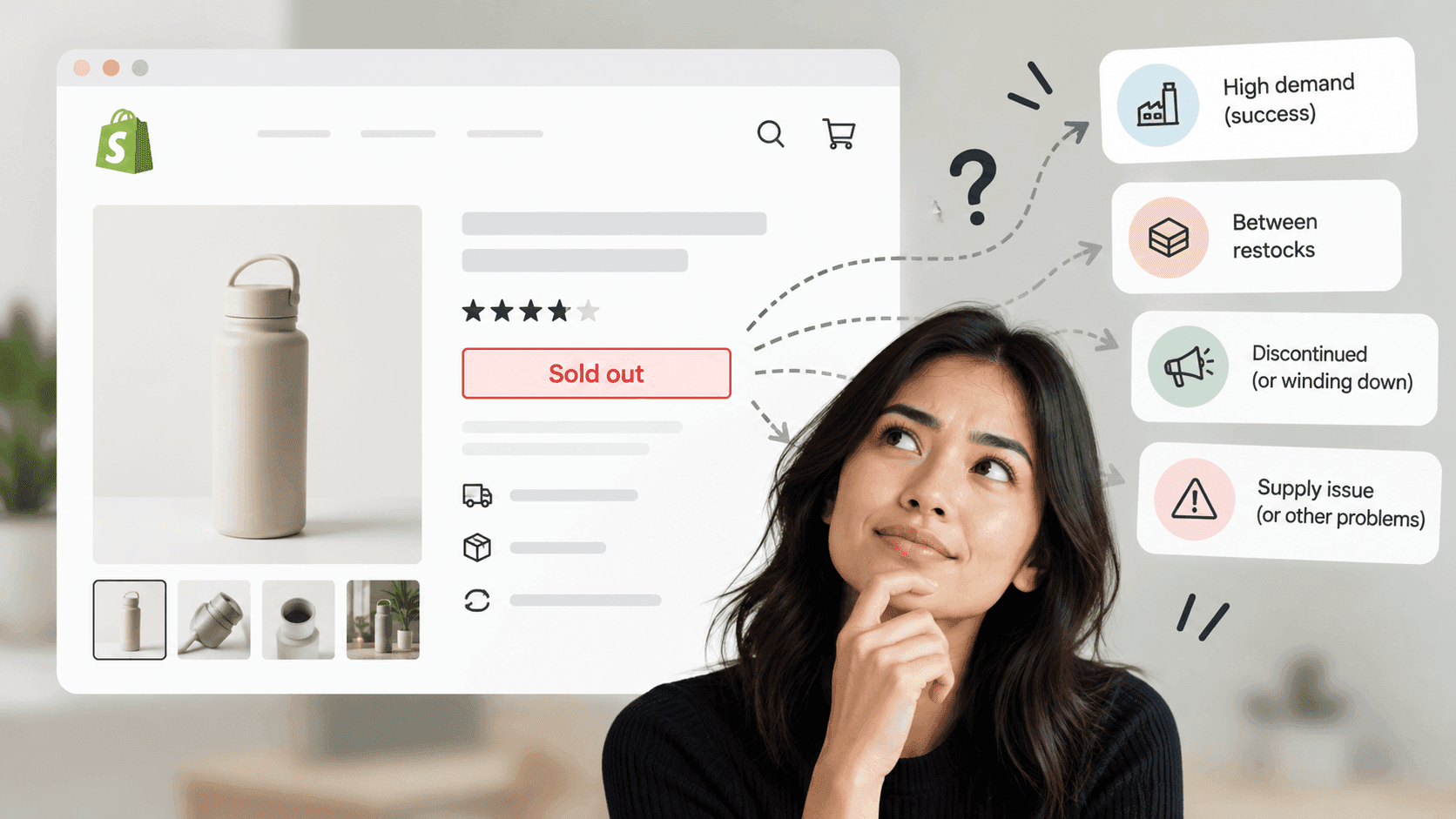
Every variant a Shopify store publishes carries a plain yes-or-no for whether it can be bought right now, so you can see exactly which sizes, colours and options are unavailable across a whole shop in a couple of minutes. What you cannot see is how many units sit behind that yes, which means a sold-out product is a much weaker signal than people assume — it can mean four completely different things, and only one of them is "this is selling well".
How to check itLink to this section
For one product: open the product page and try to select each option. Unavailable ones are usually greyed out, crossed through or replaced by a "notify me" button.
For a whole shop: pull the product list into a spreadsheet — the method is here — and look at the available field on each variant. We confirmed on a real public store on 2026-09-22 that every variant carries it.
Filter to the unavailable ones and you have, in one view: which products are partly sold out, which are completely sold out, and which options run out first.
Record the date. As with everything else in competitor research, one snapshot is a fact about today. The useful version is two snapshots.
The four things a sold-out product can meanLink to this section
This is the part that matters, and it is where most people jump to a conclusion.
1. It sold wellLink to this section
The interpretation everyone reaches for. Sometimes correct.
2. They ordered very fewLink to this section
A shop that buys twenty units of something will sell out of it quickly whether or not it is popular. Small shops and shops testing a new line do this constantly. From outside, a twenty-unit sell-out and a two-thousand-unit sell-out look identical.
3. Their supply failedLink to this section
A supplier was late, a shipment is stuck, a material ran short. Nothing to do with demand, and often the opposite of good news for the shop.
4. They are winding it downLink to this section
A product being allowed to run out, option by option, with no restock, is usually being discontinued. This is the most informative case and the easiest to spot — if you have history.
How to tell them apartLink to this section
You cannot, from one look. You can from a few, and here is what to watch for.
A product that sells out and returns quickly, repeatedly, is the closest thing to real evidence of demand you can get from outside. The shop is reordering because it works.
A product that sells out and never returns is being discontinued, or the supply problem was terminal.
One option gone, the rest full is normal. Middle sizes and popular colours go first in every shop on earth. This tells you about their size curve, not their success.
Everything gone at once is usually supply, not demand. Whole-product sell-outs across several lines at the same time almost always mean a shipment problem.
A product that has been unavailable for months but is still listed is a shop that has not tidied up, and it should be excluded from your counts — otherwise you will report a catalogue larger than the one a customer can actually buy from.
Why "sold out" is not a measurementLink to this section
Be blunt with yourself about this one, because it is the most common overreach in competitor research.
You can see that something is unavailable. You cannot see:
- how many units they started with;
- how long it took to sell them;
- whether any were sold at full price;
- whether the rest of the range is moving at all.
So "their bestseller sold out" is not a sentence the data supports. "Their product X has been unavailable since 16 September" is. The first invites a decision; the second is true. The full inventory of what is and is not visible from outside makes the same point across the board.
What it is genuinely useful forLink to this section
Spotting a gap you can fill today. A competitor out of stock on something you have is an immediate, practical opportunity — for a promotion, for a search advert, for a mention in your next email. This is the one use that justifies checking often.
Reading their size and option curve. Which options run out first tells you what their customer actually buys, which is useful when you plan your own ordering.
Catching a discontinuation early. A line quietly running down, never restocked, is a competitor exiting a category. If you were losing to them there, that is worth knowing.
Judging how tightly they run stock. A shop frequently out of things is either very lean or struggling with supply. Either way it is a reliability weakness you can compete against.
Turning it into a habitLink to this section
Weekly, on your head-to-head products only: are any of them unavailable at either shop?
Monthly, across the range: how many of their products are fully or partly unavailable, and is that number rising?
A rising unavailable count with no new products appearing is one of the clearer distress signals a shop sends from outside. A rising unavailable count alongside a stream of new products is usually just a busy shop.
Reading a whole shop's availability at onceLink to this section
The single-product view is what most people do. The shop-wide view is more useful and takes no longer.
Once the product list is in a spreadsheet, work out two numbers:
The share of variants unavailable. Every shop has some. What matters is the level and whether it moves. A shop sitting at a low, steady level is running its stock comfortably. A shop where that share climbs month after month is either growing faster than its supply or running out of money to buy stock — and from outside those look the same.
The share of products where every option is unavailable. This is the sharper signal. A few sizes gone is ordinary trading. A product with nothing buyable at all, still listed, is either awaiting a delivery or quietly finished.
Track both monthly and you get something genuinely hard to see any other way: whether a competitor's supply is under strain. It is also a fair warning to apply to yourself, since your own shop produces exactly the same numbers.
One thing worth doing immediatelyLink to this section
Before the monthly habit, do one pass right now on the products where you compete head to head. If a competitor is unavailable on something you have in stock today, that is worth acting on this week — and unlike most competitor research, it needs no history to be useful.
When watching by hand stops workingLink to this section
Availability changes daily and nothing announces it, so catching a competitor's stock-out while it still matters means checking far more often than anyone does by hand — and a stock-out you notice three weeks late is trivia rather than an opportunity.
Out-of-stock detection is one of the change types StoreLenz is being built to watch for. It is being built rather than finished today; what it does now says which is which.
Related readingLink to this section
- How to see a Shopify store's whole product catalogue
- How to see what a competitor has just launched
- What you can and cannot learn about a store from outside
SourcesLink to this section
- Our own check of a public store's product list on 2026-09-22, confirming an
availablefield on every variant - No external sources: the four interpretations above are reasoning from what is and is not visible, not measured
findings, and no statistic appears in this article
Written by Pinto Arkad
I love shopify