How to
How to find a competitor's best-selling products on Shopify
Shopify shops can sort their own products by best selling, which is the closest thing to a public bestseller list. Here is how to read it, and how far to trust it.
Published 6 min read
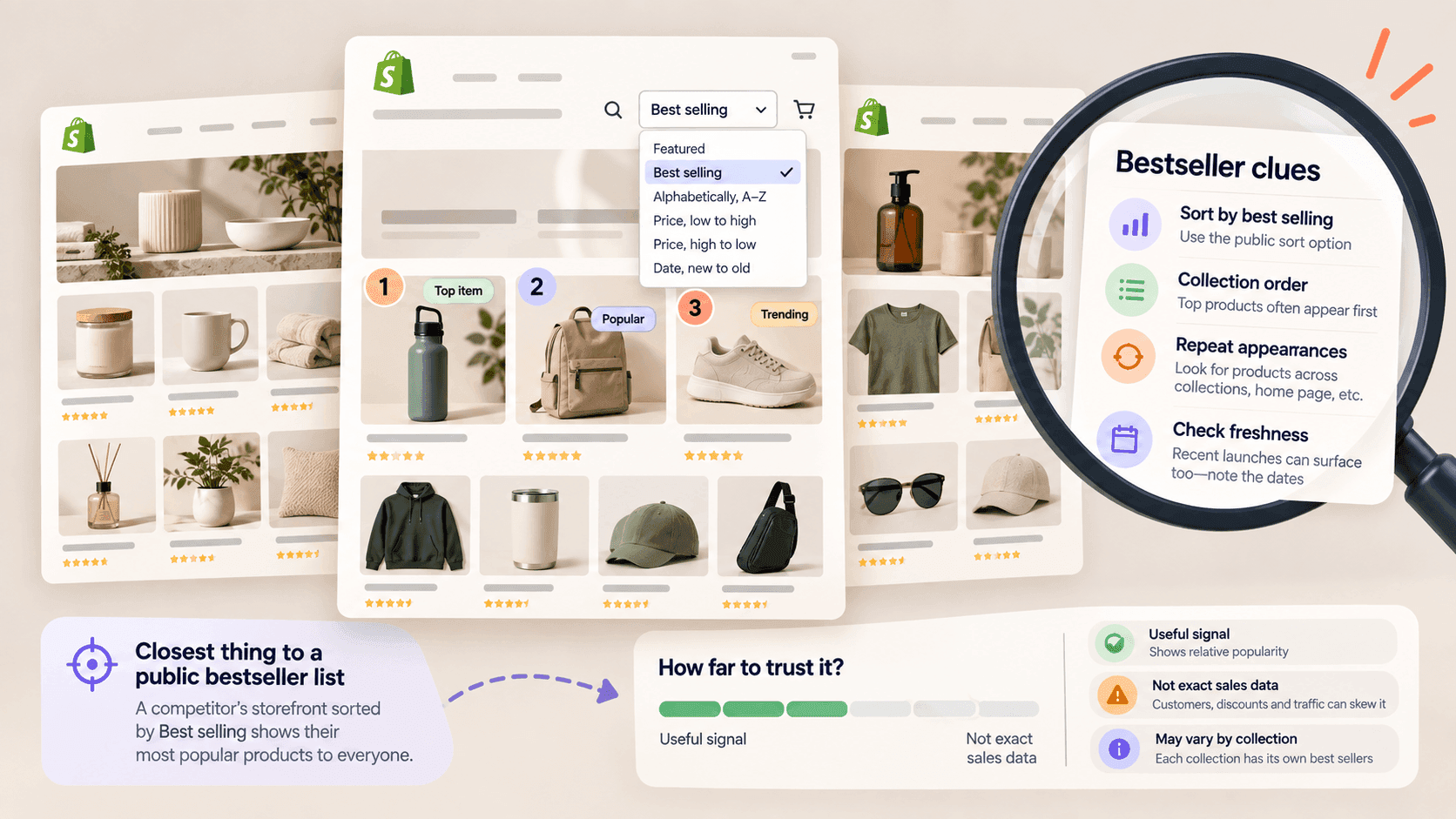
Add ?sort_by=best-selling to the end of a shop's product listing address and you will usually get that shop's own ordering of what sells. It is the closest thing to a public bestseller list that exists, it takes about ten seconds, and it comes with a real catch: it is the shop's own ranking over a period nobody states, and it shows you an order rather than any numbers.
The methodLink to this section
- Open the shop's "all products" listing. Usually
https://www.example-shop.com/collections/all. - Add
?sort_by=best-sellingto the end. - Read the first two rows.
We checked this on a real public shop on 2026-09-28: the listing loaded and best-selling was one of the genuine sort options the shop offers, alongside manual, most-relevant, title-ascending, title-descending, price-ascending, price-descending, created-ascending and created-descending.
If the address does not load, the shop may not have an "all products" collection — we tried the same address on a different well-known shop on 2026-09-22 and got a "page doesn't exist" message. Two fallbacks:
- Use any collection the shop does have and add the same
?sort_by=best-selling. A category listing sorted by bestseller is often more useful anyway, because it compares like with like. - Look for the sort control on the page. Most shops show a "Sort by" dropdown; picking "Best selling" from it does exactly the same thing without typing an address.
What "best selling" actually meansLink to this section
This is the part worth understanding, because it is where confident articles overreach.
The ordering is produced by the shop's own platform from its own sales data. You are seeing a rank, not a number: which products outsold which, over a period that is not stated anywhere on the page.
So you can honestly say "these appear to be among their stronger sellers." You cannot say how many sold, over what period, or by what margin the first beat the second.
And a shop can override it. A "manual" sort exists precisely so a merchant can arrange a collection by hand. If a listing's default order looks curated — a new launch at the top, a seasonal item first — you are looking at merchandising rather than sales, which is why you should explicitly ask for the best-selling sort rather than trust whatever order you land on.
Reading it wellLink to this section
Compare within a category, not across the shop. A shop's overall bestseller list is usually dominated by its cheapest item. Sorting a single category tells you which of their comparable products wins, which is the more useful question.
Read the top five, not the top one. Ranks near the top are close together and move week to week.
Note what is not there. A product the shop pushes hard on its home page that sits low in the bestseller sort is a product they want to sell and are not selling. That gap is genuinely valuable and almost nobody looks for it.
Watch it over time. A single reading is a snapshot of an unstated period. The same listing a month later tells you what is rising, and rising is a far stronger signal than ranking.
Three ways to corroborate itLink to this section
Because one signal is never enough:
Review counts. Public, countable, and a rough floor on how many people bought. Only a fraction of buyers ever review and that fraction is unknowable, so this is a lower bound, never a total — but a product with many times more reviews than its neighbours has almost certainly sold many times more.
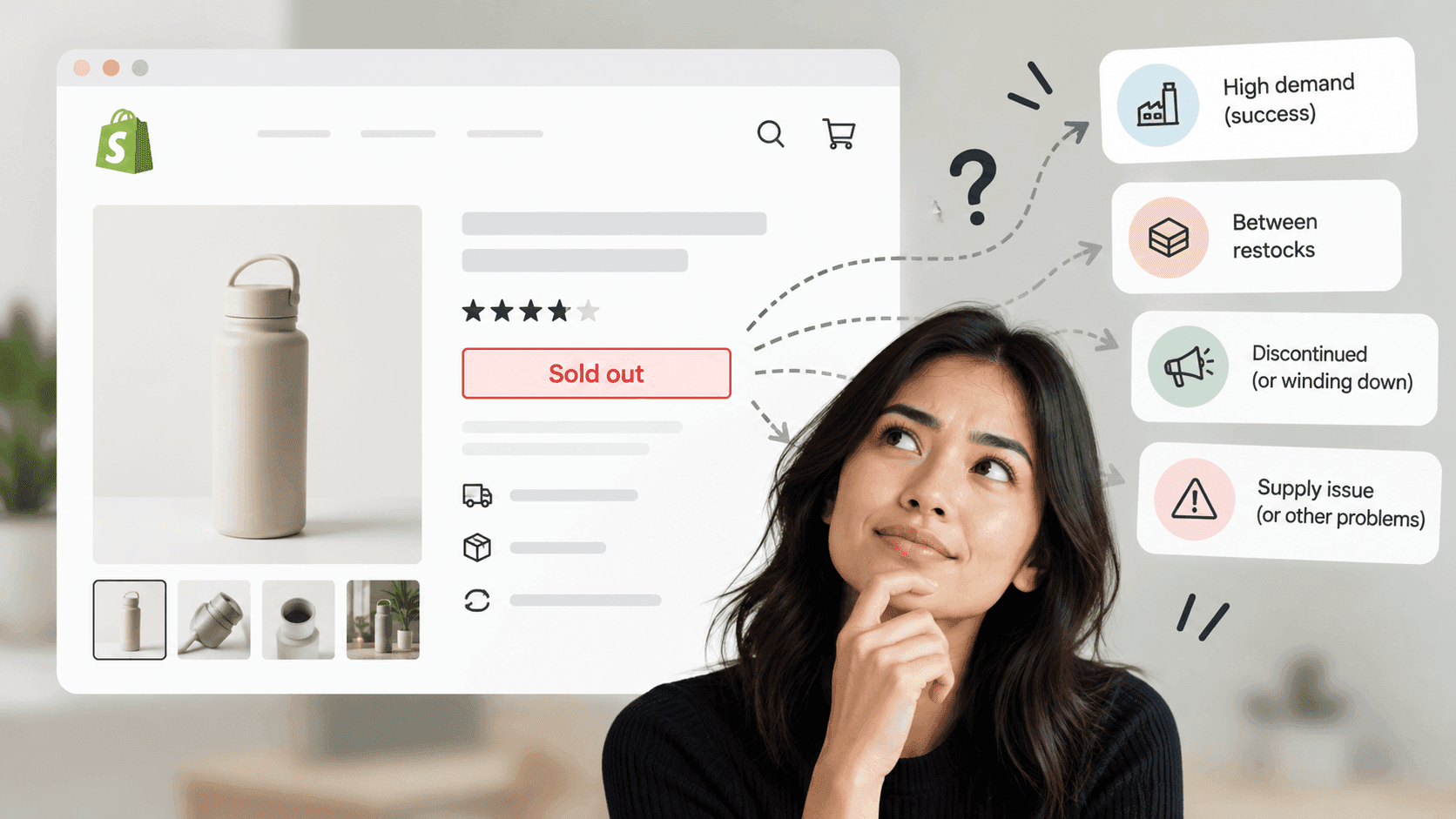
Repeated stock-outs. A product that sells out and comes back, repeatedly, is one the shop keeps reordering. That is close to real evidence of demand. A product that sells out and never returns is being discontinued — a sold-out product means four different things.
Where the shop puts it. Home page position, menu placement, bundles built around it. Merchandising follows money more often than not.
When the bestseller sort, the review counts and the stock behaviour all point at the same product, you have something worth acting on. When they disagree, trust the stock behaviour.
What this cannot tell youLink to this section
Any actual numbers. No public information says how many units of anything a shop sold. Anyone quoting a figure is modelling it.
The period. "Best selling" over what — a week, a year, all time? Not stated, and it may differ between shops.
Revenue. A bestseller by units can be the cheapest thing they sell and a small share of their takings.
Profit. The product that sells most may be the one they make least on.
Whether it would sell for you. Their bestseller is the product of their audience, their photography, their pricing and their email list. Copying it without those is the most common mistake this research leads to.
The mistake to avoidLink to this section
The temptation is to find a competitor's bestseller and add your own version. Sometimes that is right. Often it means arriving late to a product their customers already associate with them, competing on price against someone with better supplier terms.
The better use of a bestseller list is diagnostic: it tells you what their customer actually wants, which is information about the market rather than about the product. A competitor whose bestsellers are all in one narrow band is telling you where the demand in your category sits — and the gap next to it may be worth more than the thing itself.
Doing this across several shopsLink to this section
For one shop this is a ten-second check. Across five competitors, monthly, with the rankings recorded so you can see what is rising, it is the sort of repeated task that quietly stops happening — which is the whole argument for tracking rather than looking.
StoreLenz is being built to watch the shops you name and tell you what changed — new products, price moves, items going out of stock. Catalogue tracking is being built rather than finished today; what it does now says which is which.
Related readingLink to this section
- How to see every product on any Shopify store
- How to tell when a competitor's product is out of stock
- How to know when a competitor adds new products
SourcesLink to this section
- Our own check of a real public shop on 2026-09-28:
/collections/allloaded and offered the sort optionsmanual,most-relevant,best-selling,title-ascending,title-descending,price-ascending,price-descending,created-ascending,created-descending - Our own check of a different well-known public shop on 2026-09-22, where
/collections/allreturned a "page doesn't exist" message - Shopify Help Center, Finding and submitting your sitemap — https://help.shopify.com/en/manual/promoting-marketing/seo/find-site-map — read 2026-09-22
Written by Cristiano Pinto
shopify store expert